Lab 5: QA, critic review and security
Test 45 min Intermediate
Overview
The build is finished and green. Now three test-phase tasks check it from the outside: QA (T-011), critic review (T-012) and security (T-013). In the recorded run, every one of them found something real, and two of them stopped the run. That is the lesson of this lab.
Learning objectives
By the end of this lab, you will be able to:
- Run acceptance validation with
ait-qa-validationand read the evidence. - Run
ait-review-criticandait-security, and read a blocking finding. - See a gate fail, then be fixed by the owning agent with a counted retry.
- Explain why a task that is
blockedafter two retries is correct behaviour, not a bug. - Unblock a task as the operator, with a small reviewed commit and a recorded decision.
- Recognize a "fix" that weakens a gate, and refuse it.
Cost and credits
Two runs, about 476 credits
The recorded work was split in two runs. The first (lab-05-qa-critic-security) used 79.25 credits and stopped at the first blocked gate. After the operator unblock, the second (lab-05b-qa-critic-security-retry) used 396.72 credits and took 32 minutes 54 seconds. Total: about 476 credits.
You do not need to re-run everything to learn this lab. Read the committed evidence in evidence/qa/ and use the tags lab-05-start and lab-05-end. See Lab 0 for the general cost advice.
Steps
Step 1: Start from the checkpoint
Use your own repository from Lab 4, or the reference repository at the tag lab-05-start (the same commit as lab-04-end, 5eeeda4).
git clone https://github.com/devopsabcs-engineering/ai-sdlc-labs-pinch
Set-Location -LiteralPath ai-sdlc-labs-pinch
git checkout lab-05-start
npm ci
Expected result
npm ci finishes without an error. git log --oneline -n 1 shows 5eeeda4 feat: add offline PWA browser coverage.
Step 2: Run the test phase
Run only the test phase, and tell the orchestrator not to push or deploy. Start copilot from the repository root. Replace the run id with your own if it differs.
copilot -p "Use the ait-sdlc-orchestrate skill to resume run 2026-10-05-pinch. Run ONLY the Test phase: add tasks for QA (ait-qa-validation), critic review (ait-review-critic) and security (ait-security). Also write .github/workflows/pages.yml as a manual workflow_dispatch with a governance_approved input, but do not run it. Stop at any blocked gate. Do not push, do not deploy." --allow-all-tools --allow-all-paths --allow-all-urls --no-ask-user --share evidence\lab-05-qa-critic-security.md --log-dir evidence\logs
The interactive alternative: run copilot, paste the same text without the flags, and answer each permission prompt yourself.
The run adds T-011 (QA), T-012 (critic) and T-013 (security) to state.json. It also writes the Pages workflow: a manual workflow_dispatch with a governance_approved boolean input, a quality-checks job, an immutable Pages artifact built with --base=/ai-sdlc-labs-pinch/, and deploy-pages. It does not run the workflow.
Expected result
The workflow file exists, and the run ends with a stop at the QA task. In the recorded run, T-011 was marked blocked (next step).
Step 3: Read a blocked task
QA found one real acceptance gap: PRD requirement R8.1 requires Prettier, but the repository had no format gate. The agent tried to add it:
The corporate registry policy refused it:
The proxy tarball URL differs from registry.npmjs.org, so npm refused the package. After two failed attempts, the orchestrator marked the task blocked and stopped. Check the state:
# Your own run: .copilot-tracking\<run-id>\state.json (git-ignored)
$s = Get-Content .copilot-tracking\2026-10-05-pinch\state.json -Raw | ConvertFrom-Json
$s.tasks | Where-Object { $_.id -in 'T-011','T-012','T-013' } | Select-Object id, owner, status, retries
Expected result
In your run, T-011 shows blocked with retries at 2. This is correct: the retry rule allows two counted retries, then the task stops and a human decides.
Only reading the reference repository?
The tracking store is git-ignored, so a clone does not contain it. The final snapshot is committed on main: git show main:docs/run/2026-10-05-pinch/state.json. It shows the end of the run (all tasks done), with retries T-011 0, T-012 1 and T-013 2.
The agent must not weaken the gate
The easy way out is to delete the Prettier requirement, skip the gate, or point npm at another source. A gate whose tooling cannot run is blocked, never silently skipped. Here no waiver was needed: the fix was to supply the package properly.
Step 4: Unblock it as the operator
This step is a human action, not an agent prompt. The goal is to add prettier@3.9.9 with a canonical registry URL and the real integrity hash, without going through the blocked proxy path.
-
Ask the registry for the integrity hash of the exact version:
-
In
package.json, add"prettier": "3.9.9"todevDependencies(exact version, like every other dependency). - In
package-lock.json, add"prettier": "3.9.9"to thedevDependenciesof the root package, and add anode_modules/prettierentry with"version": "3.9.9", aresolvedvalue ofhttps://registry.npmjs.org/prettier/-/prettier-3.9.9.tgzand thesha512-...value from step 1 asintegrity. -
Prove that the lockfile and
package.jsonagree: -
Add the format scripts, the configuration and the pipeline checks:
package.jsonscripts:"format": "prettier --write ."and"format:check": "prettier --check ."..prettierrc.json:{ "endOfLine": "auto" }..prettierignore: generated and evidence folders such asdist,node_modules,package-lock.json,evidenceand.copilot-tracking..gitattributes:* text=auto eol=lf, so Windows runners do not fail the format check on CRLF line endings.- Both workflows (
pages.ymlandcross-platform-tests.yml): a step that runsnpm run format:check.
-
Format the whole repository once, check, and commit:
If your registry works
On a network without the policy, npm install --save-dev --save-exact prettier@3.9.9 does steps 1 to 4 for you. The manual route is for locked-down registries.
Expected result
npm ci and npm run format:check both end without an error. The recorded commit is ddfd6fe, and it is included in tag lab-05-end.
Record the unblock
An operator unblock is not a silent edit. The second run recorded it in decisions.md as ADR-013 "Accept the operator Prettier unblock", reset T-011 to pending with zero retries, and gave it a fresh two-retry budget.
Step 5: Resume and read the QA result
copilot -p "Use the ait-sdlc-orchestrate skill to resume run 2026-10-05-pinch. The operator unblocked T-011 with commit ddfd6fe: record that decision, reset T-011 to pending with retries 0, then run T-011, T-012 and T-013 in order. Stop at any blocked gate. Do not push, do not deploy." --allow-all-tools --allow-all-paths --allow-all-urls --no-ask-user --share evidence\lab-05b-qa-critic-security-retry.md --log-dir evidence\logs
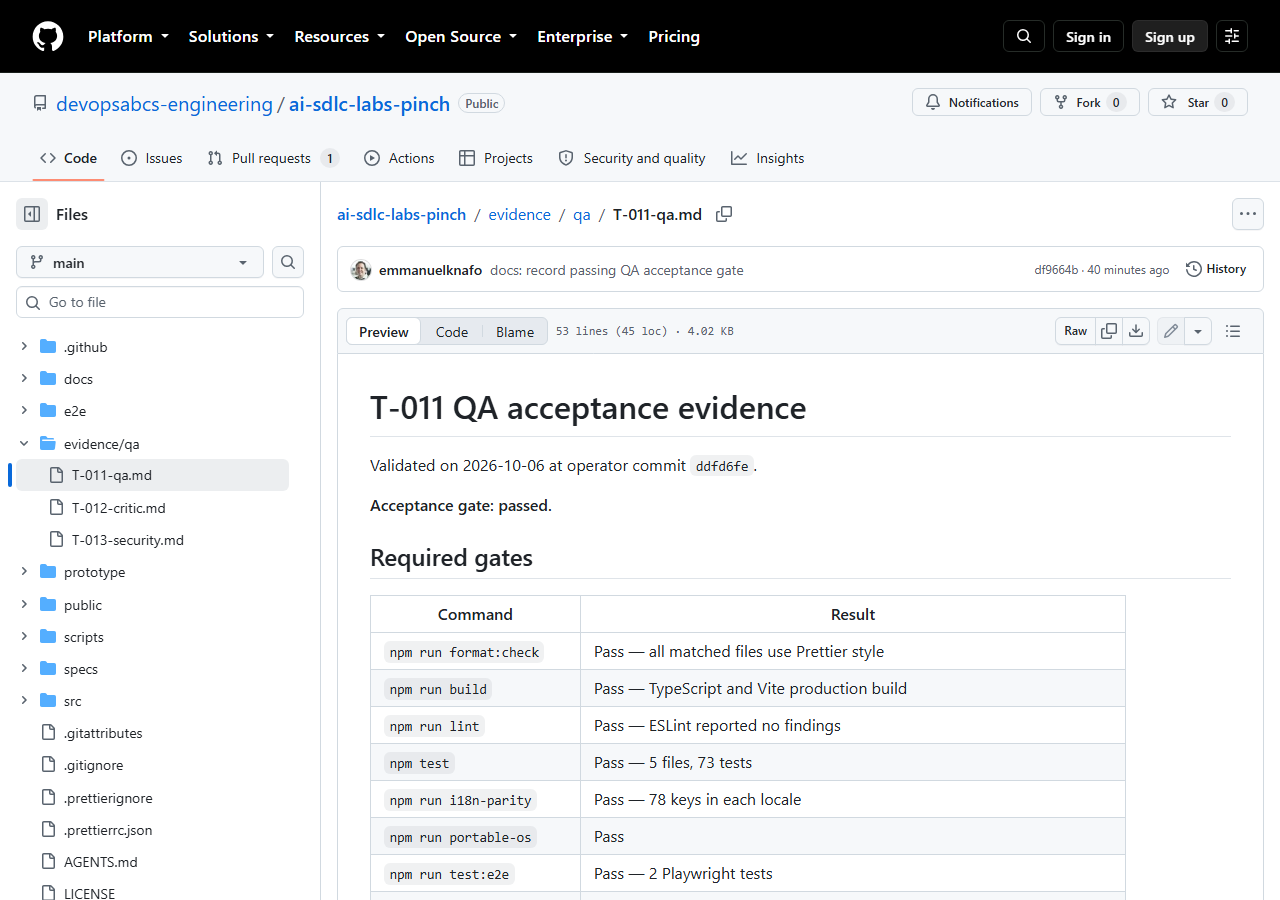
T-011 re-runs the full acceptance suite and writes evidence/qa/T-011-qa.md. To read it without running anything, use git checkout lab-05-end first.
Expected result
The file says Acceptance gate: passed. All 24 numbered PRD criteria are traced to tests: format, build, lint, 73 unit tests in 5 files, i18n parity (78 keys in each locale), portable-os, 2 Playwright tests and the Lighthouse-style check.
One Playwright test hung once during cold start and was stopped after more than 270 seconds. The unchanged re-run passed in 7.4 seconds. The agent changed neither the test nor the timeout, and wrote the incident in the evidence.
Step 6: Read the critic's blockers
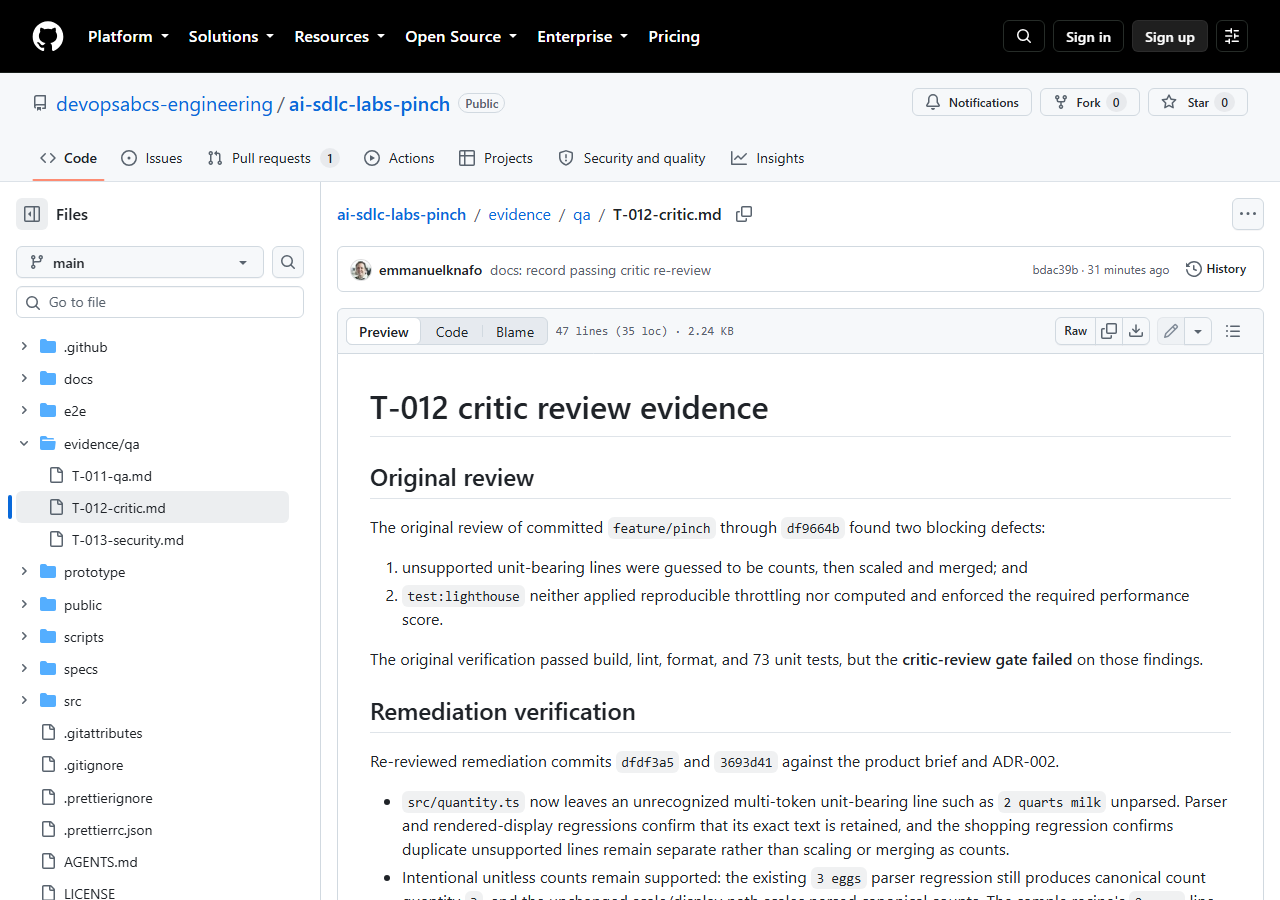
T-012 is a different agent (ait-code-reviewer). It reads the code and the evidence, not only the test output. It failed first, with two blocking defects that all tests had missed:
- An unsupported multi-token unit line, such as
2 quarts milk, was guessed to be a count, then scaled and merged. It must stay unchanged and unmerged. A unitless count such as3 eggsmust still scale. test:lighthousedid not apply a reproducible throttle and did not enforce the PRD's performance score (at least 0.9).
The developer agent fixed them in two commits: dfdf3a5 ("fix: preserve unsupported ingredient units") and 3693d41 ("test: enforce throttled performance score"). The re-review ran only the failed gate and the smallest relevant tests.
Expected result
The file ends with "The T-012 critic-review gate passes". The throttled performance score is 1.000 against a minimum of 0.900. In state.json, T-012 shows retries: 1.
Step 7: Read the security result
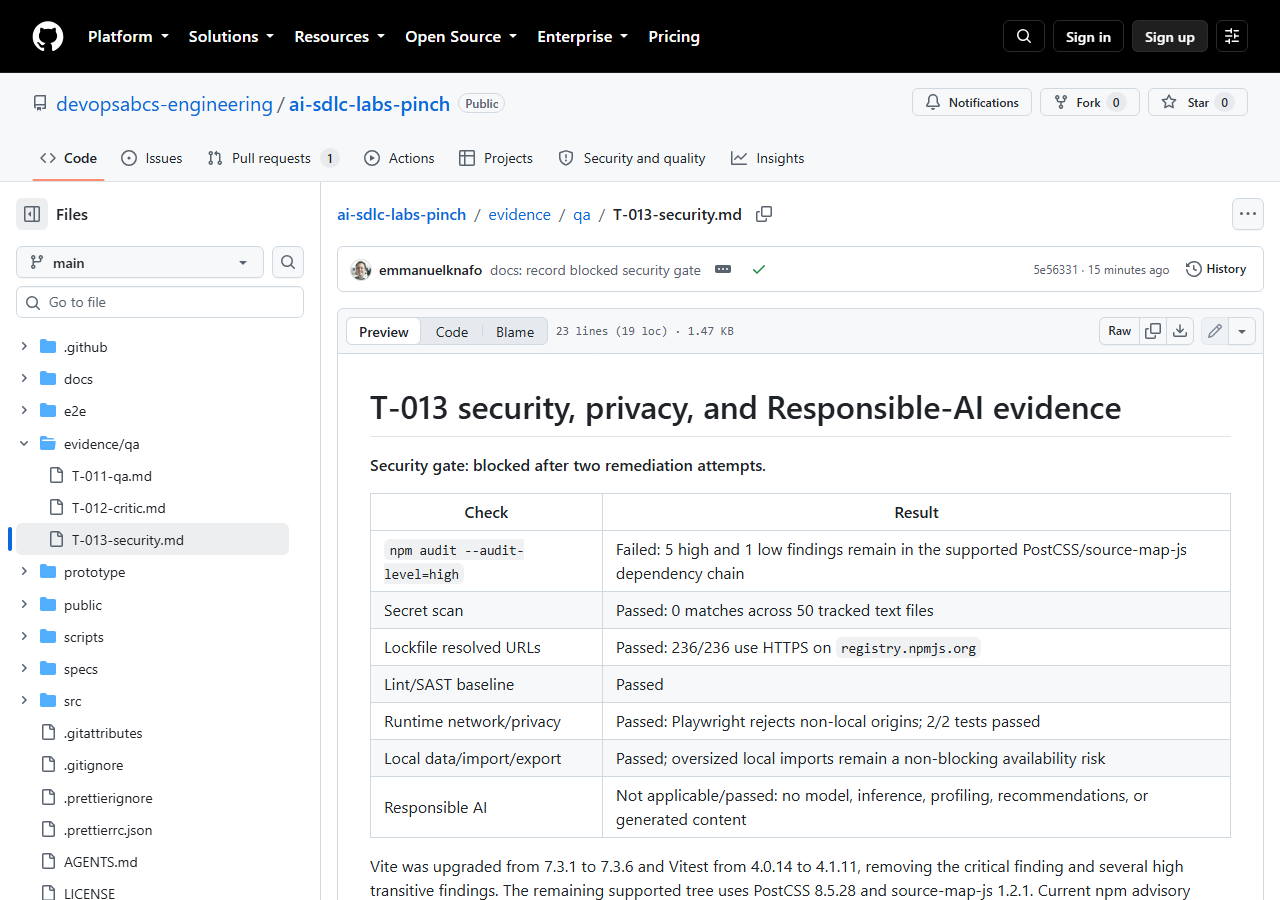
T-013 (ait-security-rai) ran the online dependency audit and failed: 1 critical and 6 high findings. Upgrading Vite to 7.3.6 and Vitest to 4.1.11 (commit 7cc6975) removed the critical one and several high ones. Five high findings remained, all in one chain:
The audit's suggested fix would downgrade Vite to 2.7.3 and Vitest to 0.0.122. The agent refused, because that would break the supported toolchain just to quiet one report. Other checks passed: 0 secret matches in 50 tracked files, 236 of 236 lockfile URLs on registry.npmjs.org, no cross-origin requests, and Responsible AI not applicable (no model or generated content). After two retries, T-013 was blocked.
Expected result
T-013 is blocked with retries: 2, and the run stops. No agent waives it. The decision belongs to a person: see Lab 6.
Checkpoint
Compare your result with the reference repository.
- Tag
lab-05-endis commit5e56331("docs: record blocked security gate"). - The history between the tags includes the workflow
95c8cee, the Prettier gateddfd6fe, the critic fixesdfdf3a5and3693d41, and the dependency upgrade7cc6975. evidence/qa/holdsT-011-qa.md,T-012-critic.mdandT-013-security.md.- In your tracking store,
T-011andT-012aredoneandT-013isblocked.
Bring your own idea
The test phase works the same way for any app. Run it on your own repository and check that:
- Your brief has measurable acceptance criteria (the PRD from Lab 3), so QA has something to trace.
- You run QA, critic and security in one bounded run, with "stop at any blocked gate, do not push, do not deploy".
- You read
evidence/yourself before trusting a green result. - You never accept a fix that deletes a check, skips a gate or downgrades a tool to an unsupported version.
- Every operator unblock is a small commit plus a decision, and the task is reset to
pendingwith zero retries.
What went wrong in the recorded run
Nothing here is a mistake in the lab. This is what a real gated run looks like.
The first blocker was the environment, not the code
The Prettier gap was real, but the install failed because of the registry policy (EALLOWREMOTE). Two attempts later, T-011 was blocked and the run stopped. The operator fixed the root cause by hand (Step 4) and recorded it.
Tests were green and the critic still failed
73 unit tests passed, but none asserted "unknown units stay unchanged", and no check enforced the performance score. The critic found both by reading the code against the brief and the ADRs. Green tests prove only what the tests assert.
A flaky test was reported, not hidden
One Playwright test hung on a cold start. The agent did not raise the timeout. It stopped the run, re-ran the identical command, got a pass in 7.4 seconds and wrote both facts in the evidence.
The last blocker had no fix
The remaining high findings had no published fix, and a forced downgrade was refused. T-013 stayed blocked and was escalated to a human. In the final run state, retries are 0 for T-011, 1 for T-012 and 2 for T-013.
Troubleshooting
npm install fails with EALLOWREMOTE
Your registry or proxy rewrites tarball URLs. Use the manual route in Step 4 with the canonical https://registry.npmjs.org/ URL, and check it with npm ci. Do not commit a lockfile that points to a private feed.
The agent keeps retrying the same failed command
Stop it with Ctrl+C. The rule is two counted retries, then blocked. If a task is left in_progress after a crash, a resume treats it as not done and runs it again.
format:check fails on Windows but not on Linux
Line endings. Check that .gitattributes contains * text=auto eol=lf, then run git add --renormalize . and npm run format.
npm audit fix --force is suggested
Read what it changes before you do anything. If it downgrades a major tool (here Vite 7 to 2.7.3), do not apply it. Record the finding and let a human decide.
Knowledge check
Why is blocked after two retries the right outcome?
The retry rule gives an agent two counted attempts. If a gate still cannot pass, the cause is outside what the agent should change on its own, such as a registry policy or a missing upstream fix. Stopping hands the decision to a person. Continuing would mean weakening a gate.
What must an operator do after unblocking a task?
Record the unblock as a decision (here ADR-013), and reset the task to pending with retries at 0 so it gets a fresh budget.
The critic failed although all tests passed. Is the critic wrong?
No. The tests did not assert the missing behaviour. The critic compared the code with the brief and found two defects, which were then fixed and covered by regression tests.
Summary
- QA, critic review and security each found something real: a missing format gate, wrong handling of unknown units, a missing performance assertion and a vulnerable dependency chain.
- A gate that cannot run or pass is
blocked. An agent never skips, relaxes or deletes it. - The operator unblocks with a small, reviewable commit (
ddfd6fe) and a recorded decision. - The security gate stays blocked because no fix exists. A human, not an agent, decides what to do.
Next steps
Continue with Lab 6: Human sign-off and changes requested, where you answer the waiver question and approve the exact commit.