Lab 3: Requirements and architecture
Plan 35 min Intermediate
Overview
The brief says what you want. The design shows how it feels. This lab turns both into a spec that an agent can build from without guessing: a product requirements document (PRD), an architecture, two decision records and a backlog of build slices.
Learning objectives
By the end of this lab, you will be able to:
- Run the product owner and architect agents with the
ait-tech-specsskill to get a PRD and a technical specification. - Read the architecture decision records (ADRs) and the numbered acceptance criteria.
- Recognize a
spec-reviewfailure, read its findings and check that the fix closes them. - Trace every requirement to a build slice, and see how project-specific gates (
i18n-parity,portable-os) enter the backlog.
Cost and credits
About 88 credits and 3.5 minutes in the recorded run
This lab is cheap: the recorded run used 88.03 credits in about 3.5 minutes, including one failed and one passed spec-review. Reading and checking the artifacts takes most of the 35 minutes. See Lab 0 for the full cost picture.
Steps
Step 1: Check the starting point
Work from the root of your practice repository, with the UTF-8 console from Lab 0. Labs 1 and 2 must be done: the brief is in specs/idea.md, the design is in docs/design/ and the prototype is in prototype/.
git status --short
git log --oneline -3
Get-ChildItem .copilot-tracking -Directory
Get-Content .copilot-tracking\<run-id>\plan.md
Replace <run-id> with the folder name from the previous command (the recorded run used 2026-10-05-pinch).
Expected result
git status is clean. In plan.md, T-001 (design) and T-002 (prototype) are checked [x], and T-003 (specification) is still open.
Reference repository only
The tracking store is git-ignored, so a fresh clone of the reference repository has none. If you only want to read the results, skip the run and open the artifacts at tag lab-03-end (see Checkpoint).
Step 2: Run the specification phase
Run one bounded phase. The prompt names the skill, the task, the outputs, and where to stop.
New-Item -ItemType Directory -Force evidence\logs | Out-Null
copilot -p "Use the ait-sdlc-orchestrate skill and resume the run. Run ONLY task T-003 with the ait-tech-specs skill: write docs/product/prd.md with numbered requirements R1.. and numbered acceptance criteria, docs/architecture/overview.md, and one ADR per binding decision. Then append the build backlog as tasks T-004 to T-010, one slice each, to state.json with requiredGates, adding the project gates i18n-parity and portable-os. Run the spec-review gate; if it fails, fix the findings and run it again. Commit with a Conventional Commit message on the current branch and stop. Do not push, do not deploy." --allow-all-tools --allow-all-paths --allow-all-urls --no-ask-user --share evidence\lab-03-requirements-architecture.md --log-dir evidence\logs
You can also run copilot interactively and paste the same prompt. In VS Code, the matching prompt is /product-specs.
Expected result
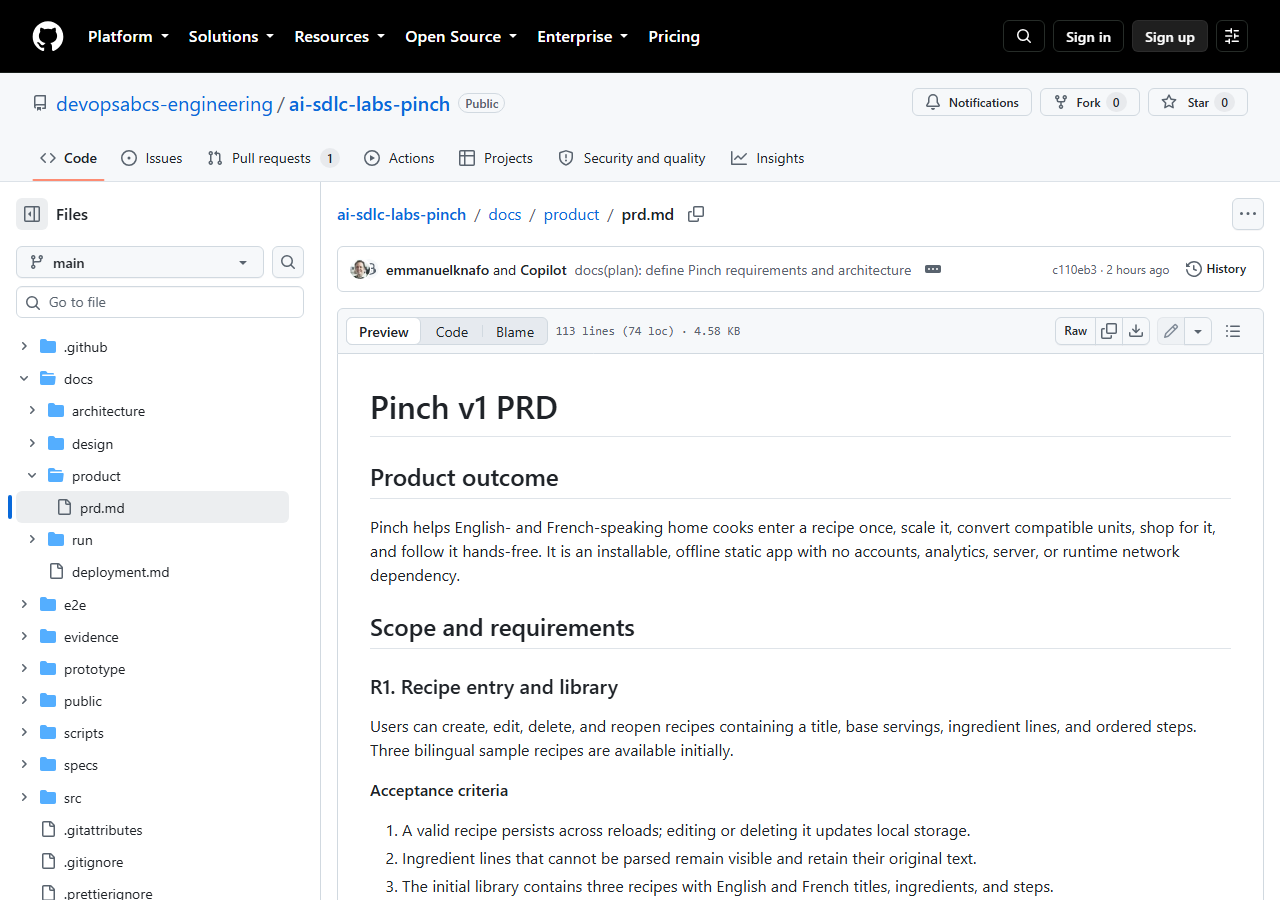
The agent ends with a result block and a commit. In the recorded run the commit was c110eb3 "docs(plan): define Pinch requirements and architecture".
Step 3: Read the PRD
Open docs/product/prd.md. It has a product outcome, requirements R1 to R8, three acceptance criteria each (24 in total), a list of non-goals and a success statement. For example, requirement R2:
### R2. Quantity scaling and unit conversion

**Acceptance criteria**

1. Integers, decimals, fractions, and mixed numbers scale by `target servings / base servings`.
2. Compatible mass and volume units use the documented conversion table; unknown or
   dimension-incompatible units remain as written.
Two habits to copy: each criterion is numbered (QA in Lab 5 verifies them one by one), and the non-goals (accounts, cloud sync, backend) say what the agents must not build.
Step 4: Read the architecture and the ADRs
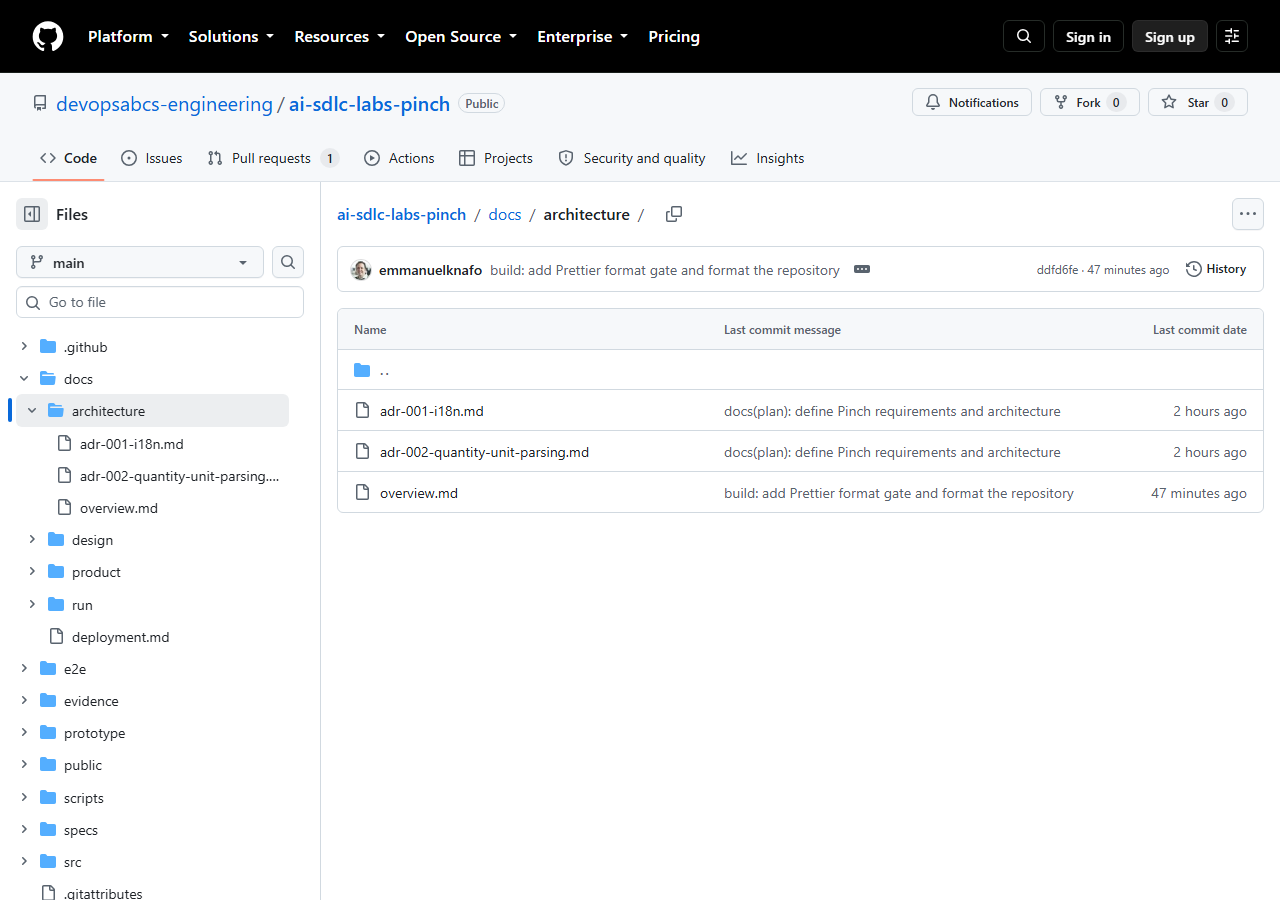
overview.md describes the solution shape (a Vite and TypeScript single-page app with no framework, no backend and no runtime third-party call), the components, the data model, the key flows and a verification map that links each concern to its evidence.
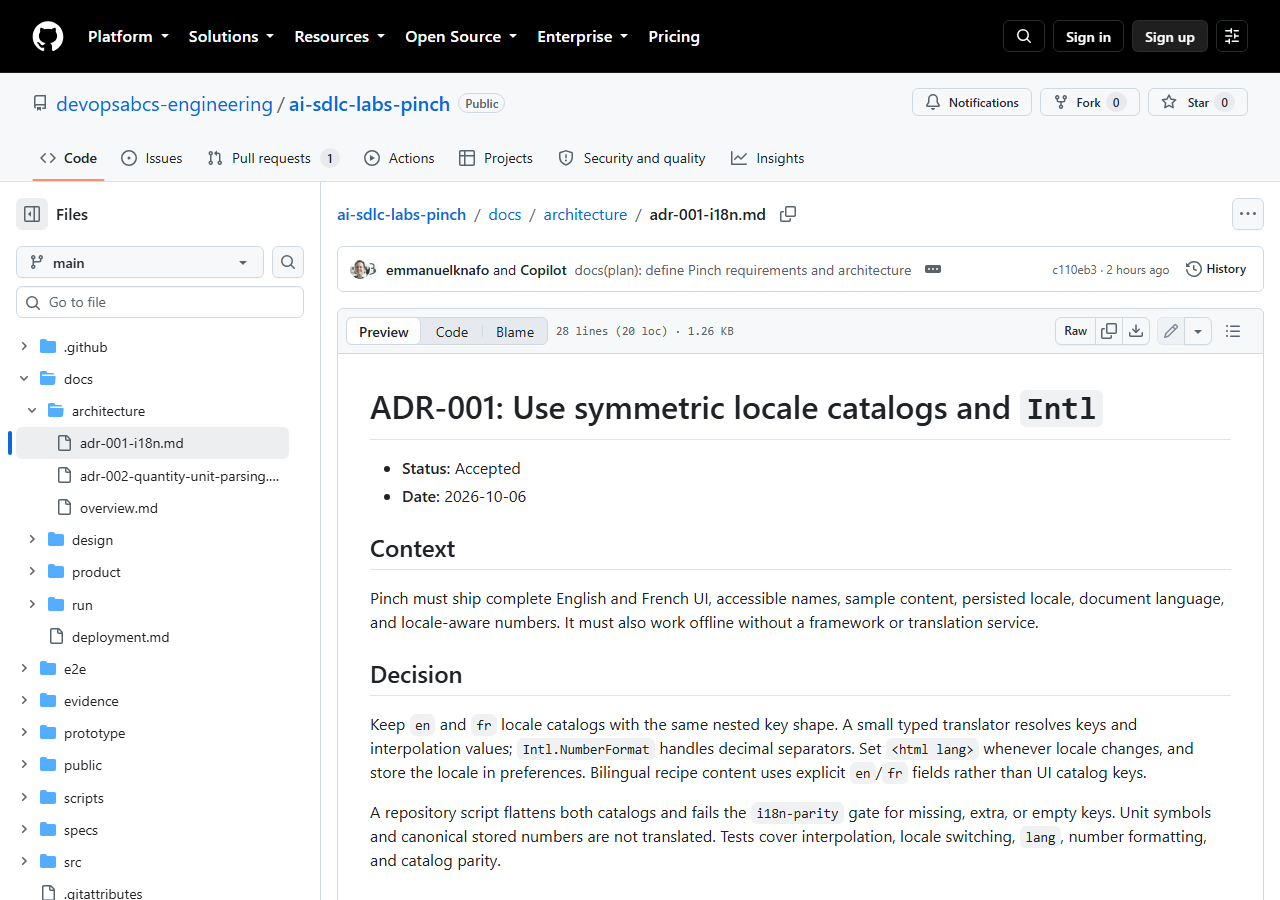
The two ADRs are short and follow Context, Decision, Consequences:
- ADR-001 keeps symmetric
enandfrcatalogs with the same key shape and adds thei18n-paritygate, which fails on missing, extra or empty keys. - ADR-002 parses only a recognized quantity prefix, converts only within the same dimension (mass or volume) and keeps unknown units and unparsed lines exactly as written.
Step 5: Look at the spec-review result
spec-review is the gate for this phase. In the recorded run it failed first and passed on the re-run. Search the shared transcript for the findings:
Select-String -Path evidence\lab-03-requirements-architecture.md -Pattern 'spec-review' | Select-Object -First 10
The three findings were real and specific:
- Conversion factors and rounding were not implementation-ready (now the conversion table and rounding rules in ADR-002).
- The data model implied that user-entered recipes needed manual bilingual duplication (now modeled as localized content with a required fallback).
- Requirements were not traceable to build slices (a traceability table was added).
Expected result
The transcript shows a failed spec-review, the fixes, and a passed re-run. Your own run can fail on different findings, or pass at the first try: model output is not deterministic. What matters is that a failed gate leads to a fix, not a shrug.
Step 6: Check the backlog and the traceability
The architect appended seven build slices to state.json. Print them with their required gates:
$s = Get-Content .copilot-tracking\<run-id>\state.json -Raw | ConvertFrom-Json
$s.tasks | Where-Object { $_.id -match '^T-0(0[3-9]|10)$' } |
  ForEach-Object { '{0}  {1}  [{2}]' -f $_.id, $_.title, ($_.requiredGates -join ', ') }
The recorded backlog is T-004 scaffold the bilingual app shell, T-005 quantity scaling and conversion, T-006 local recipe and data management, T-007 responsive recipe scaler, T-008 persistent shopping list, T-009 accessible cook mode, T-010 offline PWA and browser coverage. The two project-specific gates, i18n-parity and portable-os, come from the brief and the ADRs. Now check the other direction, from requirement to slice:
| PRD requirements | Build slice |
|---|---|
| R6, R8 | T-004 portable bilingual shell and gates |
| R2 | T-005 parsing, scaling, conversion and formatting |
| R1, R7 | T-006 recipe library and local data control |
| R2, R3, R6 | T-007 responsive recipe scaler |
| R4 | T-008 persistent shopping list |
| R5 | T-009 accessible cook mode |
| R7, R8 | T-010 offline PWA and bundled-Chromium coverage |
Expected result
T-003 is done with spec-review passed, seven new tasks exist, and every requirement R1 to R8 appears in the table at least once.
Checkpoint
The checkpoint is tag lab-03-end (commit c110eb3) in ai-sdlc-labs-pinch.
What you should see
The diff lists four files and 308 insertions: docs/product/prd.md, docs/architecture/overview.md and the two ADRs. The backlog is not in the commit: state.json lives in the git-ignored tracking store. Return to your branch with git switch -.
Bring your own idea
The flow is the same for any idea. Run the specification phase on your own brief and design.
- Your brief lists 3 or 4 features. Do not exceed that.
- The PRD has numbered requirements, and each has numbered acceptance criteria you could test.
- Non-goals are listed, so the agents do not add features.
- The backlog has 5 to 7 slices, each small enough to build and verify in one task.
- Every requirement maps to at least one slice in a traceability table.
- Any rule you care about (for example, bilingual parity or no hard-coded paths) became a named gate.
What went wrong in the recorded run
spec-reviewfailed at first. It found unusable conversion rules, a data model that forced duplicate bilingual content, and no requirement-to-slice traceability. The agent fixed all three and the gate passed on the second run.- Nothing else. There was no blocked task in this lab. The tracking store is git-ignored, so the backlog lives only in
state.jsonuntil you snapshot it.
Troubleshooting
The PRD has criteria that cannot be tested
Ask for a narrower rewrite of the one requirement, for example: "Rewrite R4 so each acceptance criterion is observable in a browser or a unit test." Run spec-review again.
spec-review keeps failing
After two failed retries the task becomes blocked, which is the designed behavior. Read the findings in the transcript, fix the root cause yourself or record a decision in decisions.md, then resume the run.
T-004 to T-010 are missing from state.json
The agent stopped before it appended the backlog. Resume with: Use the ait-sdlc-orchestrate skill and resume the run. T-003 is incomplete: append the build backlog T-004 to T-010 and run spec-review. Stop after that.
Knowledge check
Why does a requirement need a build slice?
A requirement with no slice is never built, and nothing notices. The traceability table makes that visible before any code exists.
Where does i18n-parity come from?
From ADR-001 and the brief. It is a project-specific gate that the architect added to the requiredGates of the slices that touch the catalogs.
Summary
You turned a brief and a design into a PRD with 24 numbered acceptance criteria, an architecture overview, two ADRs and a backlog of seven slices, and you watched spec-review stop a spec that was not ready. The recorded run cost 88.03 credits.
Next steps
Continue with Lab 4: Build in slices, where the orchestrator builds the app one slice at a time.