Lab 4: Build in slices
Build 60 min Intermediate
Overview
This is where code appears. You run two bounded build phases. The orchestrator builds seven slices, checks each one with the gates from Lab 3 and commits each one separately.
Learning objectives
By the end of this lab, you will be able to:
- Read how the orchestrator decomposes the spec into atomic tasks in
state.jsonandtasks.md. - Run a bounded build phase and stop it at a gate.
- Explain the
build,lintandunitgates and the project gatesi18n-parityandportable-os. - Follow the inbox and the Scribe: how agents report without editing shared files.
- Commit once per task so a bad task is easy to roll back.
Cost and credits
The most expensive lab so far: about 763 credits and 48 minutes
The recorded build used two bounded runs:
| Run | Tasks | Credits | Time |
|---|---|---|---|
lab-04a-build-slices-1 |
T-004 to T-007 | 394.17 | 28 min 39 s |
lab-04b-build-slices-2 |
T-008 to T-010 | 368.57 | 19 min 23 s |
Total: about 763 credits and 48 minutes of agent time. You can stop at the end of any slice with Ctrl+C and resume later. To save credits, follow the recorded commits and jump to the checkpoint. See Lab 0 for the cost picture.
Steps
Step 1: Check the starting point
You need the specification from Lab 3 and Node.js from Lab 0.
git status --short
node --version
$s = Get-Content .copilot-tracking\<run-id>\state.json -Raw | ConvertFrom-Json
$s.tasks | Where-Object { $_.id -match '^T-0(0[4-9]|10)$' } | Select-Object id, title, status
Replace <run-id> with your run folder (the recorded run used 2026-10-05-pinch).
Expected result
The working tree is clean and tasks T-004 to T-010 are pending. The brief requires every script to run on Linux and Windows, so use a current Node.js LTS.
Step 2: Build the first four slices
Run one bounded phase. The prompt tells the orchestrator what to do per task and where to stop.
copilot -p "Use the ait-sdlc-orchestrate skill and resume the run. Run ONLY the build tasks T-004, T-005, T-006 and T-007, one at a time, in dependency order. For each task: dispatch ait-frontend-dev, then re-run the task's requiredGates yourself, record the result in state.json, archive the inbox handoff, and make one Conventional Commit. Stop after T-007. Do not push, do not deploy." --allow-all-tools --allow-all-paths --allow-all-urls --no-ask-user --share evidence\lab-04a-build-slices-1.md --log-dir evidence\logs
You can also run copilot interactively and paste the same prompt. In VS Code, the matching prompt is /product-implement.
Let it finish a slice
If you interrupt in the middle of a task, state.json keeps it as in_progress. On resume the orchestrator treats it as not done and runs it again. That is safe, but you pay for the slice twice.
Expected result
The run ends with four commits: feat: scaffold bilingual app shell, feat: add quantity scaling and conversion, feat: add local recipe data management and feat: build responsive recipe scaler.
Step 3: Read what one slice looks like
Every slice follows the same seven moves. This is the orchestrator's job; the developer agent only writes code.
- Pick the first task that is
pendingand whose dependencies aredone. - Mark it
in_progressinstate.jsonand dispatchait-frontend-devwith the task, its acceptance criteria and its required gates. - The developer writes code and tests, then returns a result block and writes one inbox file. It never edits
plan.md,tasks.mdorstate.json. - The orchestrator re-runs the required gates itself. It does not trust the developer's report.
- It records each gate result in
state.json(gateResults) and marks the taskdoneonly if every required gate ispassed. - It archives the inbox handoff into
inbox\processed\and updateschanges.md. - It makes one Conventional Commit.
Look at the evidence after the run:
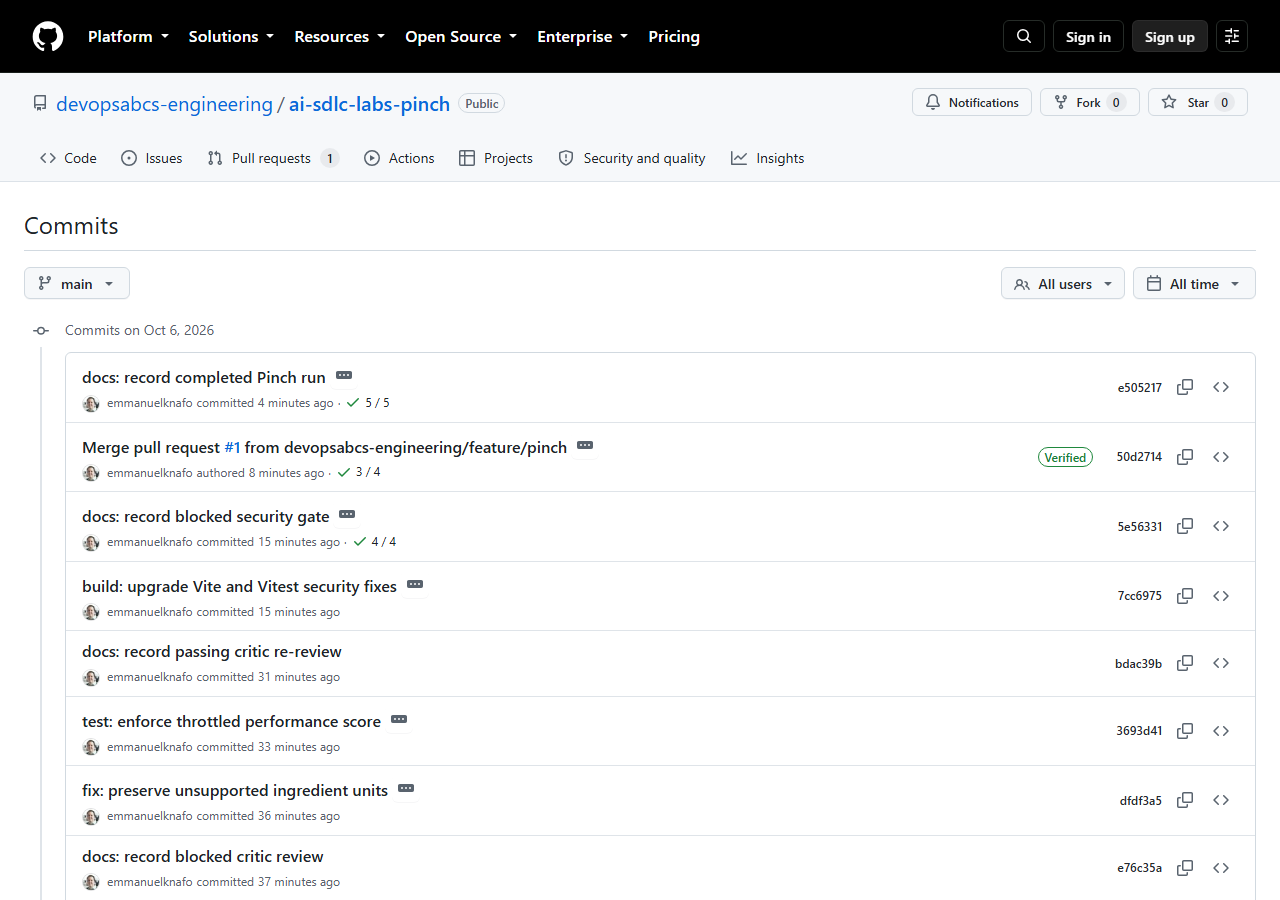
git log --oneline -8
Get-ChildItem .copilot-tracking\<run-id>\inbox\processed | Select-Object -Last 4 Name
$s = Get-Content .copilot-tracking\<run-id>\state.json -Raw | ConvertFrom-Json
$s.tasks | Where-Object { $_.id -match '^T-0(0[4-7])$' } | Select-Object id, status, retries
Expected result
The log shows one commit per task, inbox\processed\ holds the archived handoffs, and T-004 to T-007 are done.
Step 4: Run the gates yourself
The gates are ordinary npm scripts. Run the same five the orchestrator ran. Do not trust a green report you have not seen go green.
Expected result
Every command exits without an error. At the end of T-007 Vitest reports 65 unit tests and each language catalog has 61 keys.
The i18n gate
npm run i18n-parity flattens src/catalogs/en.json and src/catalogs/fr.json and fails if a key is missing, extra or empty. Delete one key from fr.json, run it, see it fail, then restore the file with git checkout src/catalogs/fr.json.
Step 5: Build the last three slices
copilot -p "Use the ait-sdlc-orchestrate skill and resume the run. Run ONLY the build tasks T-008, T-009 and T-010, one at a time, in dependency order. For each task: dispatch ait-frontend-dev, then re-run the task's requiredGates yourself, record the result in state.json, archive the inbox handoff, and make one Conventional Commit. Stop after T-010. Do not push, do not deploy." --allow-all-tools --allow-all-paths --allow-all-urls --no-ask-user --share evidence\lab-04b-build-slices-2.md --log-dir evidence\logs
For the browser checks of T-010, install Playwright's own Chromium once, then run them:
Expected result
Three more commits. At the end the repository has 73 unit tests, 78 catalog keys per locale, 2 Playwright end-to-end tests and a Lighthouse-style browser check, all passing.
Step 6: Review the seven slices
| Task | Commit | Slice | Unit tests | Catalog keys per locale |
|---|---|---|---|---|
| T-004 | 3ca36ef |
Scaffold bilingual app shell | 5 | 18 |
| T-005 | 575e462 |
Quantity scaling and conversion | 48 | no change |
| T-006 | 2ae8930 |
Local recipe data management | 61 | 42 |
| T-007 | 219a8b9 |
Responsive recipe scaler | 65 | 61 |
| T-008 | 87cbef3 |
Persistent shopping list | 70 | 69 |
| T-009 | d4542cf |
Accessible cook mode | 73 | 78 |
| T-010 | 5eeeda4 |
Offline PWA and browser coverage | 73 | 78 |
T-010 adds no unit tests but brings 2 Playwright end-to-end tests and the Lighthouse-style check. Note the order: T-008 (shopping list) and T-009 (cook mode) both depend on T-007, not on each other.
Step 7: Try the app
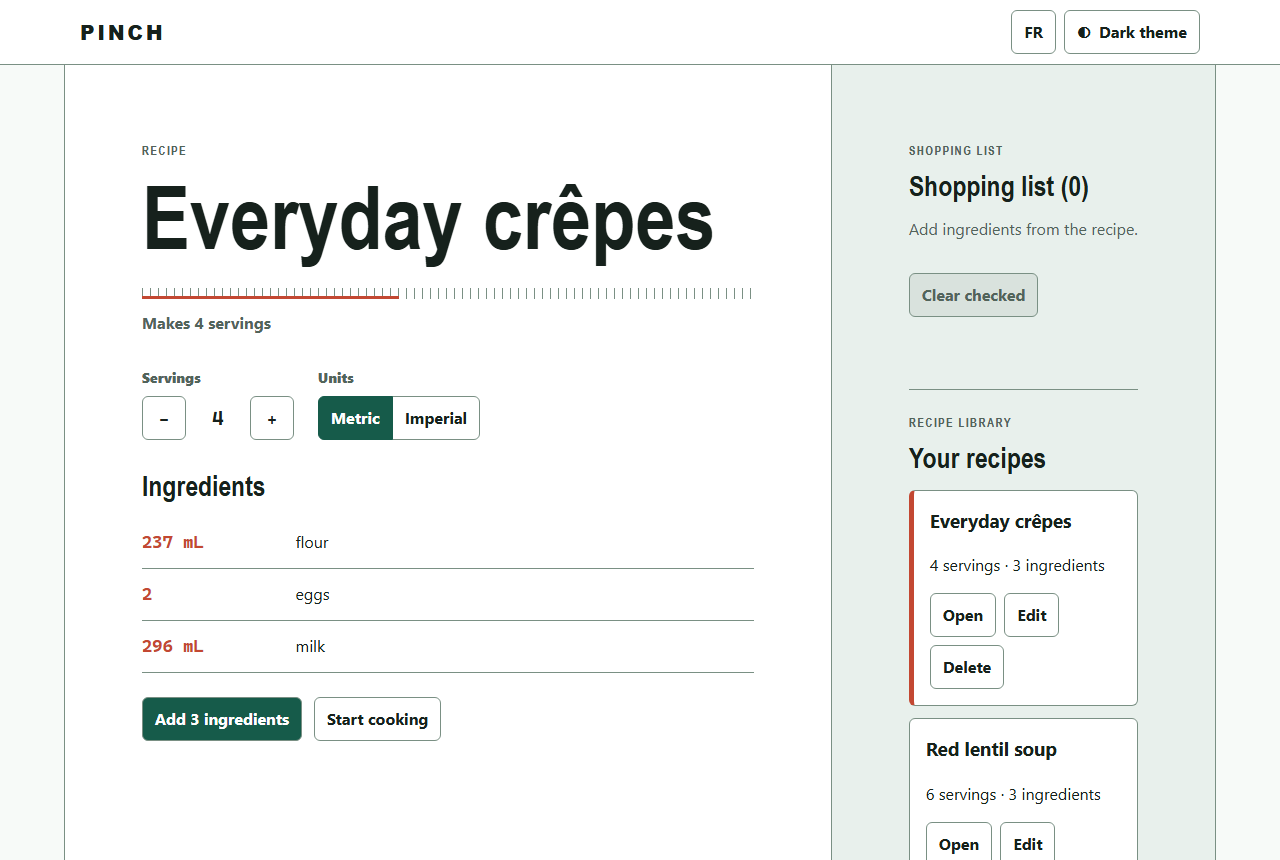
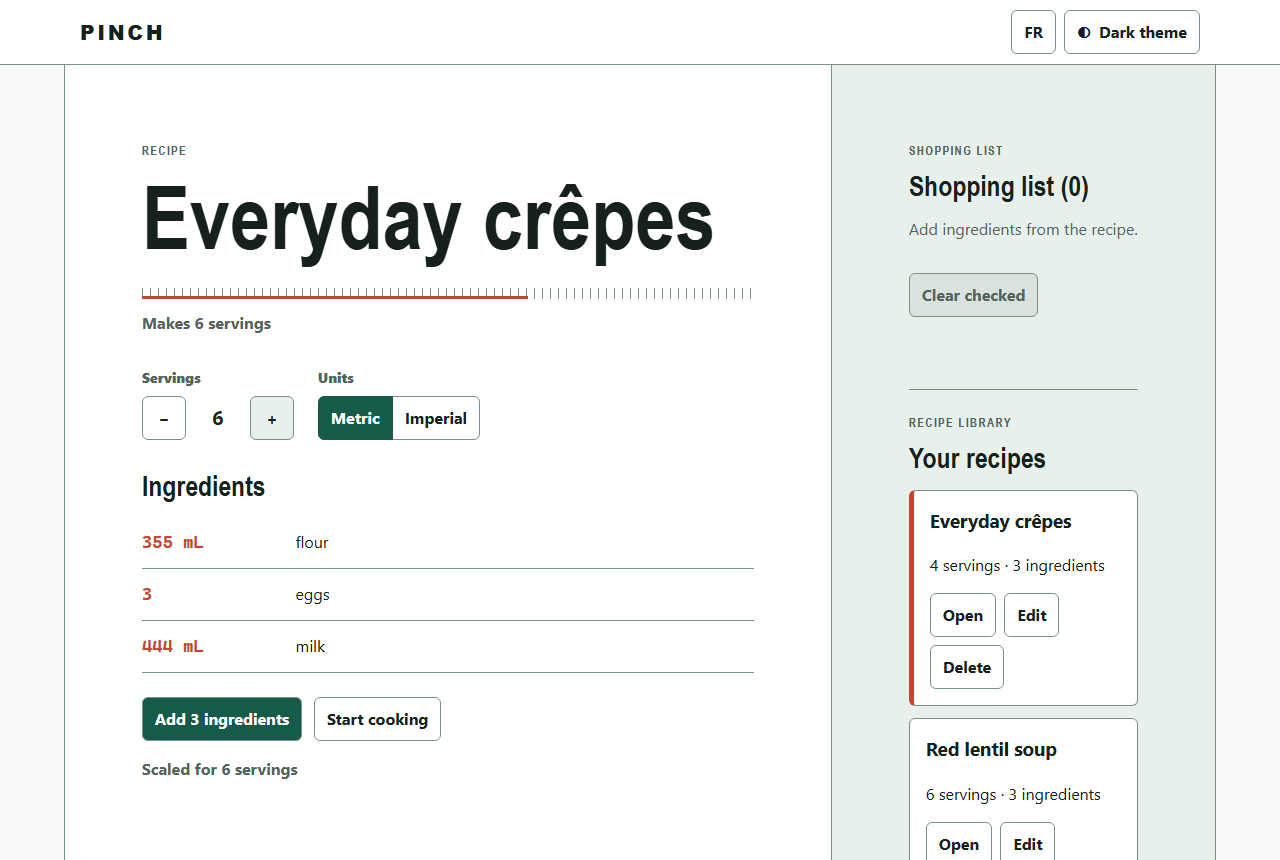
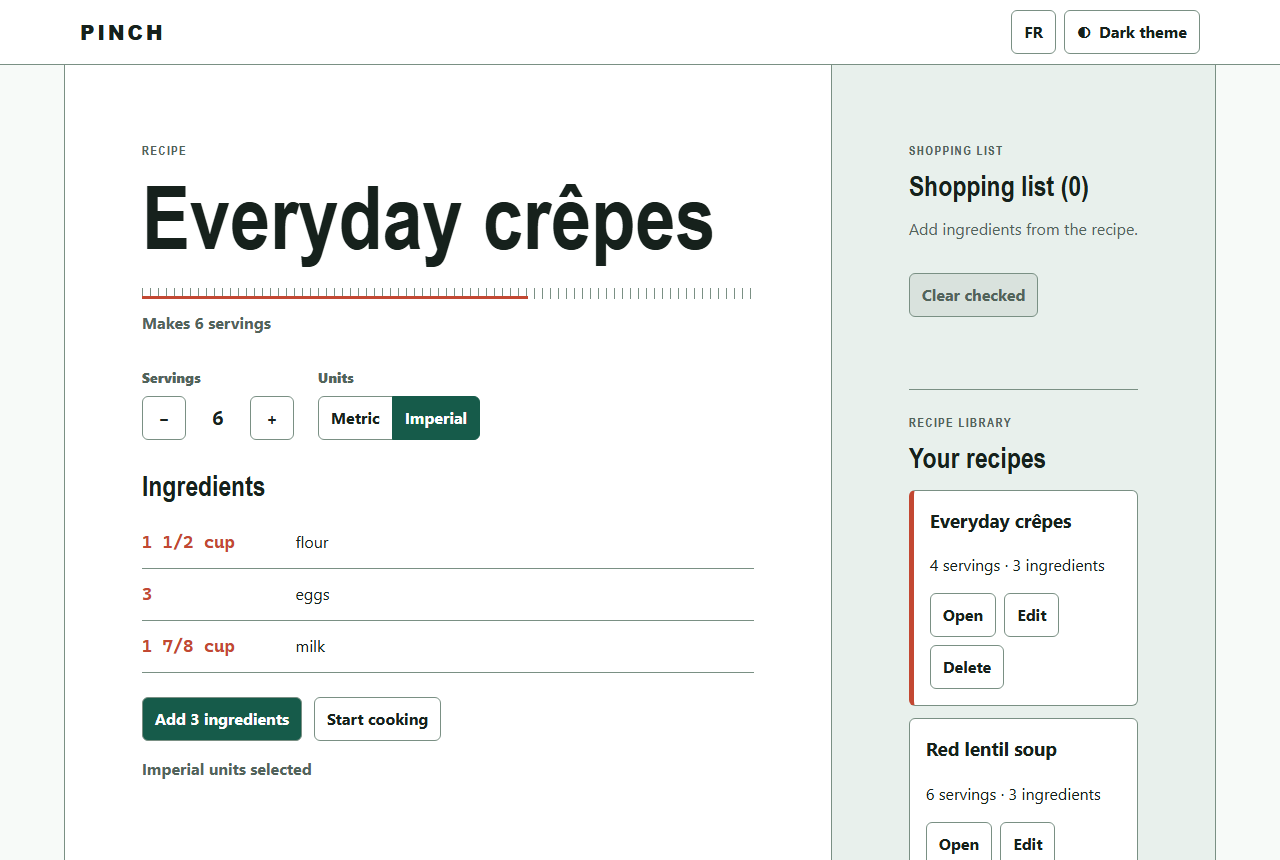
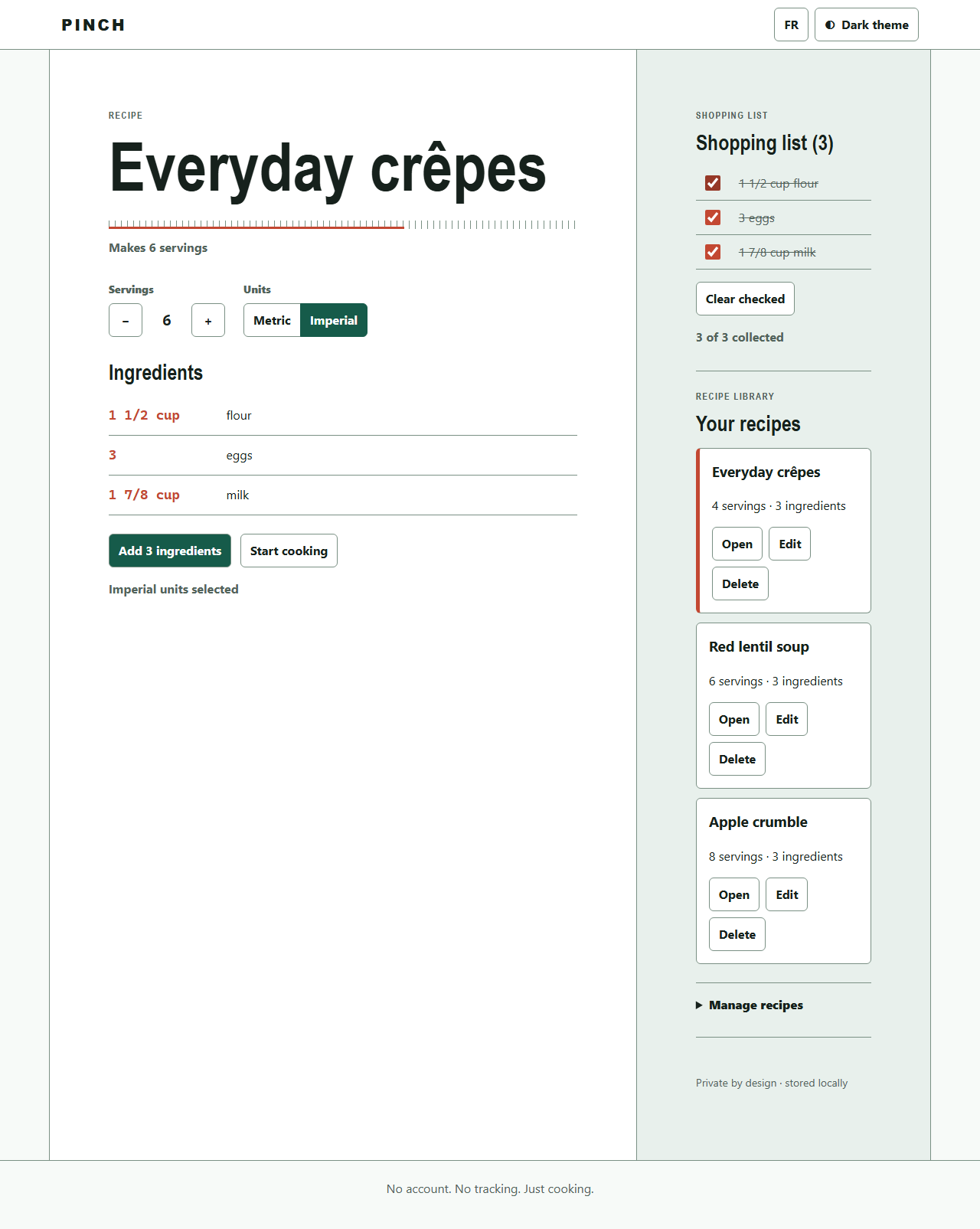
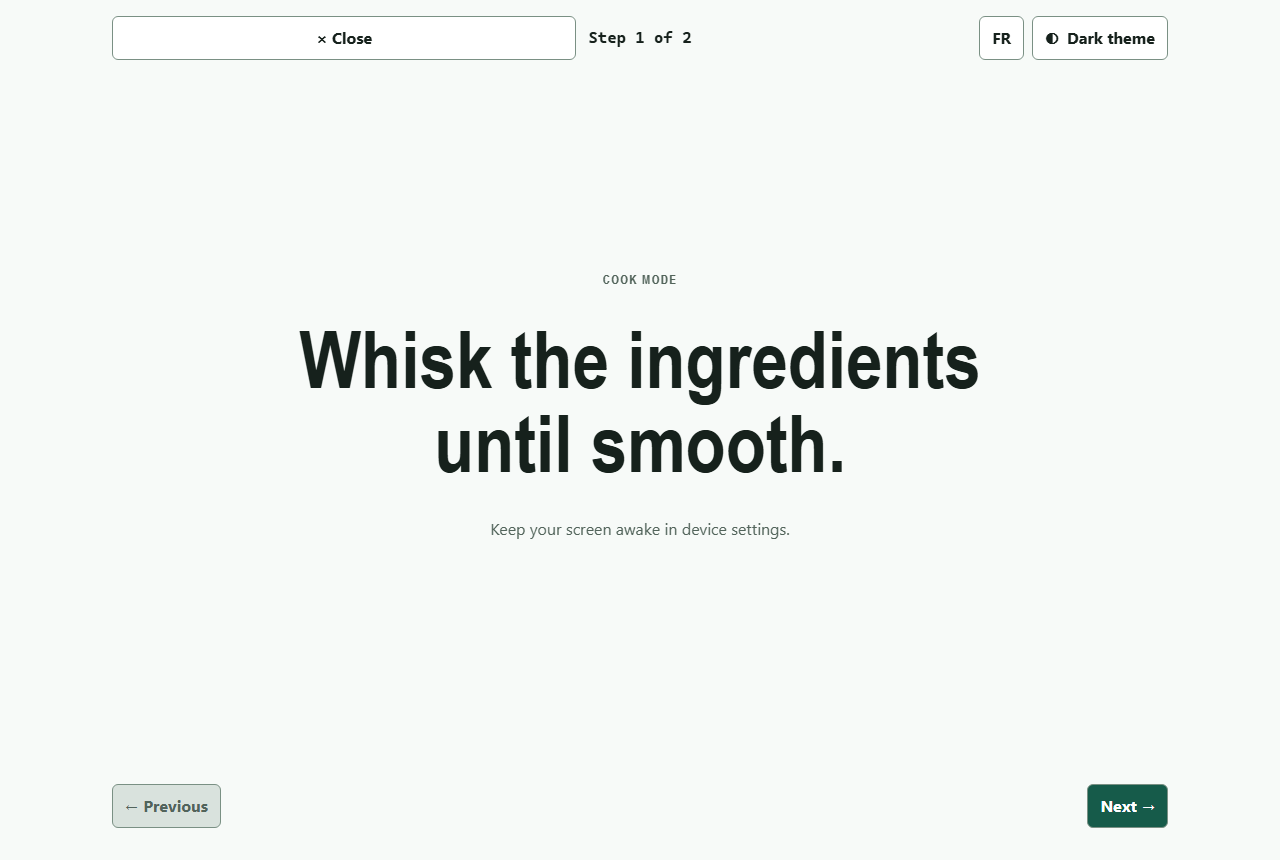
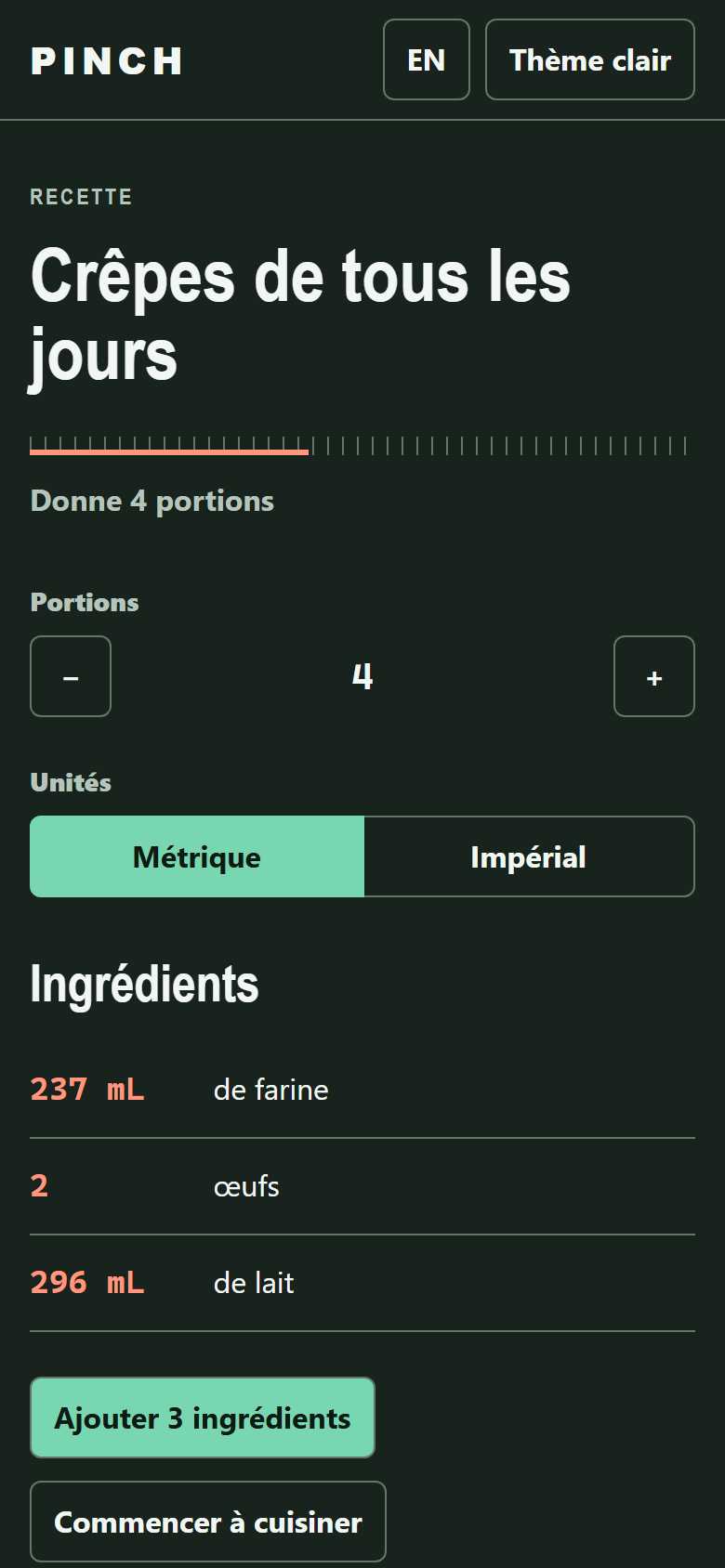
Open the local address Vite prints; it includes the base path /ai-sdlc-labs-pinch/. The screenshots below come from the live app. Compare them to what you see: the recipe at four servings, then six, then imperial units, then cook mode.
Checkpoint
The checkpoint is tag lab-04-end (commit 5eeeda4) in ai-sdlc-labs-pinch.
git diff lab-04-start lab-04-end --stat
git log lab-04-start..lab-04-end --oneline
git checkout lab-04-end
npm ci; npm test
What you should see
The diff reports 31 changed files and 7,486 insertions (it includes package-lock.json). The log lists exactly the seven feat: commits of the table. npm test reports 73 tests. Return to your branch with git switch -.
Bring your own idea
Same flow, your own spec from Lab 3.
- Keep 3 or 4 features and 5 to 7 slices. Credits grow with every slice.
- One slice, one task, one commit, one set of required gates.
- Run at most three or four slices per
copilot -pcall and end the prompt withStop after T-0NN. - Pin dependencies to exact versions and commit
package-lock.jsonwithregistry.npmjs.orgURLs. - Add a project gate for any rule you care about, as a script the orchestrator can run.
- Re-run the gates yourself before you move to the next lab.
What went wrong in the recorded run
- A gate command that did not exist. The orchestrator's first full gate command used
npm run check:i18n. The script is namedi18n-parity. It noticed the error and re-ran the correct script. The lesson: a gate command is part of the spec, so name the scripts in the ADR. - T-010 went green on Windows only. The orchestrator checked the cross-platform wiring itself and had the developer add a test-only workflow,
cross-platform-tests.yml, that runs onubuntu-latestandwindows-latestand useschromium.executablePath()with no hard-coded browser path. - The Scribe could not consolidate. The scribe sub-agent has no read tool, so the orchestrator merged the inbox handoffs itself. This is a documented plugin limitation, not a failure of your setup.
Troubleshooting
A gate fails with Missing script
Open package.json and compare the script names with the gate names. In Pinch the i18n gate is i18n-parity. Ask the orchestrator to fix its command, not your scripts.
npm ci or CI fails on registry URLs
Behind a corporate npm proxy the lockfile can record proxy URLs that break CI. Check that every resolved URL points to registry.npmjs.org:
(Select-String -Path package-lock.json -Pattern '"resolved"' | Where-Object { $_.Line -notmatch 'registry\.npmjs\.org' }).Count
The count must be 0. If not, set npm config set registry https://registry.npmjs.org/ and regenerate the lockfile.
The browser tests cannot find Chromium
Run npx playwright install chromium once. On Linux CI, use npx playwright install --with-deps chromium. The tests use the bundled Chromium only.
The run stopped in the middle of a slice
Resume with: Use the ait-sdlc-orchestrate skill and resume the run. Continue with the first unfinished build task and stop after T-0NN. Finished tasks are never redone.
Knowledge check
Why does the orchestrator re-run the gates instead of trusting the developer?
The developer is the author of the code, so its report is a claim, not evidence. An independent re-run turns the claim into a result recorded in state.json.
Why one commit per task?
A bad task becomes one commit you can revert, and the commit list reads like the backlog.
Summary
You built Pinch in seven slices: 73 unit tests, 78 catalog keys per locale, 2 end-to-end tests and a browser quality check, each slice verified by gates and committed once. The two runs cost about 763 credits.
Next steps
Continue with Lab 5: QA, critic review and security, where independent agents try to break what you just built.