[!IMPORTANT] Use synthetic prompts only. LLM message logging stays off on every API, so the lab never records prompts or completions in telemetry; only token counts and bounded dimensions leave the gateway. Session images appear on this site only after a maintainer reviews sanitized evidence.
Overview
| Item | Value |
|---|---|
| Duration | 30 minutes, including ingestion delay |
| Level | Advanced |
| Prerequisites | Lab 03 completed and a deployed session environment |
The platform API ai-gateway-api, served at /ai-gateway, has three team products, team-retail, team-finance, and team-hr. Each has its own product-scoped subscription (team-retail-sub, team-finance-sub, and team-hr-sub) and its own limits: 3,000, 2,000, and 1,000 tokens per minute, and 30,000, 20,000, and 10,000 tokens per day. The gateway derives the team from the authenticated subscription, never from a caller header. scripts/generate_traffic.py sends a small, bounded workload per team, and scripts/showback_report.py turns the resulting token metrics into an estimated showback.
[!WARNING] Every output is labelled
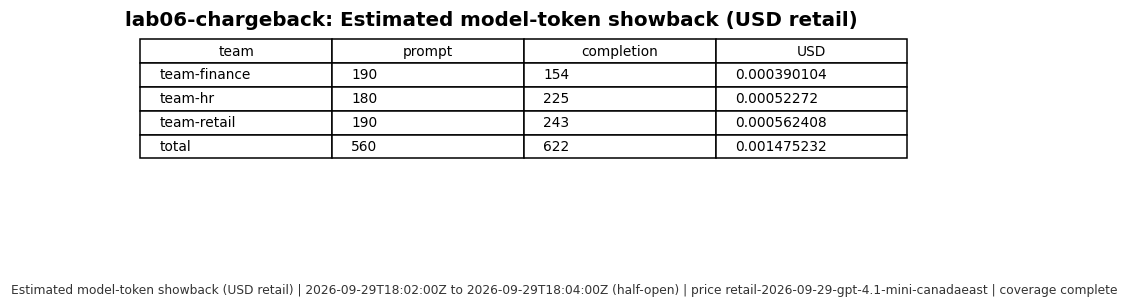
Estimated model-token showback (USD retail)with its UTC interval, price snapshot, coverage state, and exclusions. It is an estimate at uncached retail prices, not a billed chargeback. It excludes shared APIM, logging, Content Safety, networking, taxes, contract discounts and adjustments, prompt-cache discounts, and provisioned-throughput pricing. Missing, duplicated, or unpriced coverage suppresses the total, and missing telemetry is reported as incomplete, never as zero. Reconcile with Cost Management or the invoice before using any figure financially.
Learning Objectives
By the end of this lab, you will be able to:
- Explain how team attribution comes from subscription mapping and why
ClientAppstays a caller assertion - Describe the bounded traffic envelope and its fixed half-open UTC window
- Reconcile metric sums against the response-usage manifest
- Read the coverage state, reconciliation status, and exclusions of a showback report
- Explain which subscriptions can bypass product quotas
Exercises
Exercise 6.1: Read the team attribution design
Get-Content policies/platform-ai-gateway.xml
Get-Content policies/platform-team-product.xml
Expected result: the platform policy emits one token metric with the dimensions API ID, Subscription ID, and ClientApp, normalizes ClientApp against the allowlist retail-web, finance-batch, and hr-assistant, reporting any other value as unknown, and deletes the Ocp-Apim-Subscription-Key header, the subscription-key query parameter, and any api-key header before forwarding. The team product policy applies llm-token-limit with a counter-key of the subscription ID.
Exercise 6.2: Understand the traffic envelope
Traffic runs inside a full-session or run-existing session after readiness and scope probes pass.
Expected result: you can state the defaults: one worker, 30 attempts, 128 maximum output tokens, 10,000 reserved tokens, a five-minute deadline, serial non-streaming calls, and no retries. Keys are retrieved privately and never printed, and every call reserves against the session envelope.
The generator records a response-usage manifest and a fixed half-open UTC window in outputs/showback/<session_id>/manifest.json. A workflow lock does not stop human traffic, so a window that contains unaccounted calls is rejected as contaminated.
Exercise 6.3: Read the showback report
Expected result: the report queries one representation only, the Application Insights customMetrics table summed by valueSum, scoped to the component, the observed metric namespace, the platform API, the three teams, and the window. It reconciles prompt and completion sums against the manifest within an explicit tolerance and prices them with exactly one rate per model, version, SKU, region, currency, effective period, and unit from scripts/prices/<snapshot>.json.
A report with complete coverage shows totals. A report with partial coverage labels known values as partial. A report with missing usage, attribution, or prices suppresses the total and records the unattributed, unpriced, failed, and ambiguous counts.
Exercise 6.4 (Hands-on): Run a report-only session
gh workflow run lab-session.yml -f mode=report-only -f generation=<generation> -f confirm_resource_group=<resource-group> -f report_window_start=<start-utc> -f report_window_end=<end-utc>
Expected result: the window is accepted only when both values are UTC, the start precedes the end, the end is not in the future, and the span is at most 24 hours. Without a traffic manifest, the report is labelled unreconciled and never claims a complete total. The environment is preserved whatever the outcome.
Exercise 6.5: Know the quota bypass
Expected result: you can explain that product policies do not apply to API-scoped, all-APIs, or built-in all-access subscriptions. The session’s scope probe records the behavior of product-scoped team keys, a temporary API-scoped test subscription that is deleted afterwards, and the anonymous path, which must return 401. The built-in all-access key is never used.
Exercise 6.6: Review the session evidence
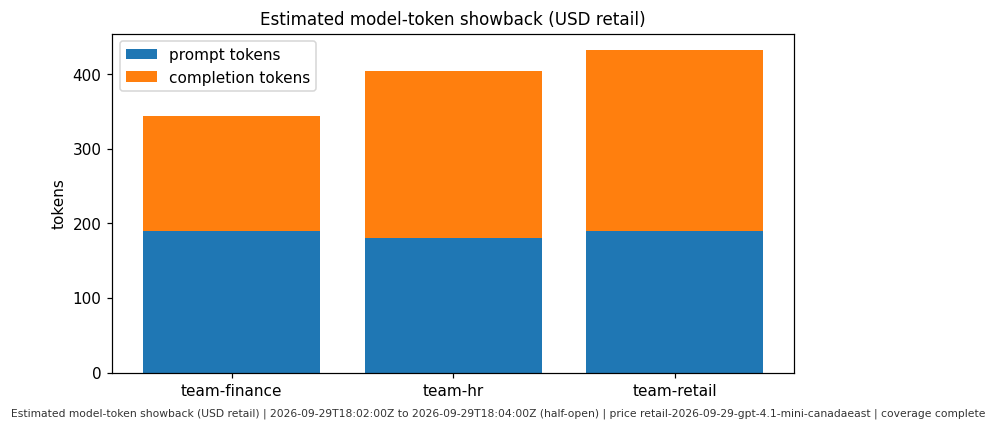
[!NOTE] Reviewed evidence from session
36608221120-1(workflow run), rendered on 2026-09-29 from sanitized results only. Amounts are estimated model-token showback at retail prices, not billed charges.
Validation Checklist
- Every chart and table carries the estimated showback label, interval, snapshot, coverage, and exclusions
- The window was exclusive to the approved traffic
- Metric sums reconciled with the usage manifest, or the report says why not
- No complete total appears when any coverage is missing
- Report-only output is labelled
unreconciled
Knowledge Check
- Why does the slug say chargeback while every output says estimated showback?
- Why is summing both
customMetricsand workspaceAppMetricsa double count? - Which costs does the estimate exclude, and why?
- What makes a measurement window contaminated?
Next Steps
Continue to Lab 07: Teardown and residual cost exposure.