[!IMPORTANT] Use synthetic prompts only. LLM message logging stays off on every API, so the lab never records prompts or completions in telemetry; only token counts and bounded dimensions leave the gateway. Session images appear on this site only after a maintainer reviews sanitized evidence.
Overview
| Item | Value |
|---|---|
| Duration | 30 minutes |
| Level | Intermediate |
| Prerequisites | Lab 01 completed with a persisted .env |
AI workloads are billed and throttled by tokens, not requests. notebooks/demo1-token-limits.ipynb applies the provider-agnostic llm-token-limit policy at API scope so one element enforces both a tokens-per-minute limit, returning 429 with Retry-After, and a daily token quota, returning 403.
A dedicated APIM subscription and an x-demo-run suffix in the policy counter key isolate this lab’s counters from other runs, other demonstrations, and any other traffic on the same instance.
[!NOTE] A backend
429is not proof of the gateway limit. Thedemo1.rate_limit_429objective passes only with gateway provenance, such as theremaining-tokenspolicy headers, and a quota403is never evidence of a content safety decision.
Learning Objectives
By the end of this lab, you will be able to:
- Read an
llm-token-limitpolicy and name the attribute behind each observed status - Interpret the
tokens-consumed,remaining-tokens, andremaining-quota-tokensheaders - Distinguish a gateway tokens-per-minute
429from a backend throttle and from a quota403 - Reset every counter for the lab without waiting for a window to roll over
- Explain how the session budget bounds the burst and accumulation loops
Exercises
Exercise 2.1: Read the policy
Get-Content policies/demo1-token-limit.xml
Expected result: one llm-token-limit element sets tokens-per-minute, token-quota, token-quota-period="Daily", estimate-prompt-tokens="false", and a counter-key that combines the subscription ID with the x-demo-run header.
The limit values come from named values rather than literals, and the backend authenticates with the APIM managed identity. The policy strips the client subscription key header and query parameter before forwarding, so the key never reaches the model backend.
Exercise 2.2 (Hands-on): Make a baseline call
Open notebooks/demo1-token-limits.ipynb and run the cells through the baseline call.
The baseline cell first sends unscored warm-up calls until the new API, subscription, and policy answer through the gateway. APIM applies new configuration asynchronously, so a fresh instance can return 404 or 401 for about a minute. The warm-up uses its own x-demo-run value, so the Demo 1 counters start clean.
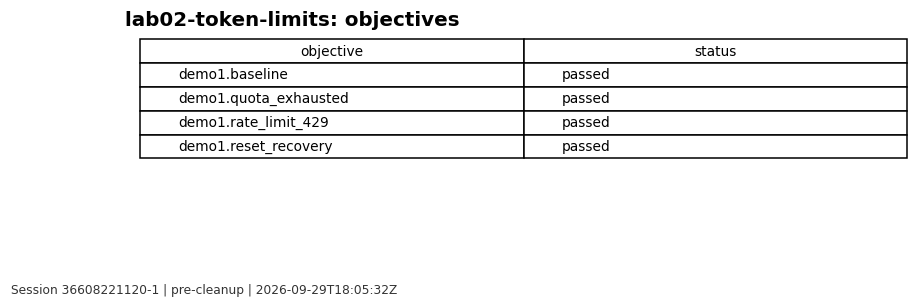
Expected result: one 200 response with the three token headers present. This records the demo1.baseline objective.
With estimate-prompt-tokens="false", tokens-consumed reflects the prompt and completion usage the model reported.
Exercise 2.3 (Hands-on): Burst to a 429
Run the burst section.
Expected result: a bounded loop of rapid requests ends in a 429 with a Retry-After header, and the chart shows remaining-tokens falling across the burst. This records demo1.rate_limit_429 when the gateway headers confirm the source.
Exercise 2.4 (Hands-on): Accumulate to the daily 403
Run the accumulation section.
Expected result: the loop honors each Retry-After, remaining-quota-tokens decreases toward zero, and the gateway returns 403 once the daily quota is exhausted. This records demo1.quota_exhausted.
Both loops stop at a maximum iteration count and a wall-clock limit. In an automated session, every call also reserves input and maximum output tokens against the shared session envelope before it is sent, and a reservation that does not fit stops the loop with BudgetExceeded.
Exercise 2.5 (Hands-on): Reset the counters
Run the reset section.
Expected result: a new DEMO_RUN value is persisted to .env, and the follow-up call succeeds immediately. This records demo1.reset_recovery.
The resources stay in place because later labs reuse the same APIM instance.
Exercise 2.6: Review the session evidence
[!NOTE] Reviewed evidence from session
36608221120-1(workflow run), rendered on 2026-09-29 from sanitized results only.
Validation Checklist
- The baseline response carried all three token headers
- The
429carriedRetry-Afterand gateway provenance - The
403appeared only afterremaining-quota-tokensreached zero - A new
DEMO_RUNvalue restored service immediately - All four Demo 1 objectives have a recorded status
Knowledge Check
- Which
llm-token-limitattribute produces the429, and which produces the403? - Why does a
429from the model backend fail thedemo1.rate_limit_429objective? - How does changing
DEMO_RUNreset the counters without touching the policy? - Why can APIM token limits overshoot under concurrent traffic?
Next Steps
Continue to Lab 03: Token metrics.