[!IMPORTANT] Use synthetic prompts only. LLM message logging stays off on every API, so the lab never records prompts or completions in telemetry; only token counts and bounded dimensions leave the gateway. Session images appear on this site only after a maintainer reviews sanitized evidence.
Overview
| Item | Value |
|---|---|
| Duration | 35 minutes |
| Level | Intermediate |
| Prerequisites | Lab 03 completed and an Azure AI Content Safety resource configured in .env |
notebooks/demo3-content-safety.ipynb applies one policy in two directions. The inbound llm-content-safety instance checks prompts with the prompt shield and four harm categories (Hate, SelfHarm, Sexual, and Violence) on the 0 to 7 scale. The outbound instance re-checks completions with a sliding window, because models can produce unsafe content from benign prompts.
Choosing a threshold is a business decision for your Responsible AI reviewers, not an engineering default. The shipped defaults are 4 for every category.
[!WARNING] Content safety results can be inconclusive. Every response is classified as
policy_block_confirmed,not_tripped,transport_error, orinconclusive. A block counts only with policy-specific evidence, such as the content-safety error body or headers; a403without that provenance fails the safety objective. For streaming, a missing[DONE]event alone isinconclusive. An inconclusive required objective prevents any claim that every lab succeeded, and the privacy baseline is never weakened to obtain a result.
Learning Objectives
By the end of this lab, you will be able to:
- Explain why inbound checks alone cannot protect completions
- Run a versioned fixture matrix instead of improvising harmful examples
- Classify each result by provenance rather than by status code alone
- Interpret a
not_trippedresult and choose an approved next step - Explain how a streaming intervention differs from a
403
Exercises
Exercise 4.1: Read the policy
Get-Content policies/demo3-content-safety.xml
Expected result: two llm-content-safety elements. The inbound element sets shield-prompt="true", the category thresholds from named values, and enforce-on-completions="true"; the outbound element sets window-size and window-overlap-size.
On a block, the <on-error> section returns a JSON body and the x-content-safety-decision and x-content-safety-reason headers as evidence.
Exercise 4.2: Review the fixture rule
Select-String -Path shared/fixtures.py -Pattern "FIXTURE_SET_VERSION"
Expected result: the fixture set carries a version stamp.
The shipped prompt-attack, harm-threshold, and streaming fixtures are mild, non-graphic placeholders that exercise the mechanism only. Replace them with your organization’s pre-approved evaluation set before delivering the lab to an audience. Never improvise harmful examples live.
To use an approved set without editing code, set DEMO3_FIXTURES_FILE to a JSON file with a version string and a fixtures object that defines safe_business_prompt, prompt_injection, harm_threshold, and streaming_completion, each with case, input_label, prompt, expected_status, and expected_evidence. The notebook refuses an incomplete file instead of mixing it with the placeholders. Keep the approved file out of source control unless your Responsible AI team approves publishing it.
Exercise 4.3 (Hands-on): Run the test matrix
Open notebooks/demo3-content-safety.ipynb and run through the test matrix.
The matrix cell first sends unscored warm-up calls until the new API, subscription, and policy answer through the gateway, because APIM applies new configuration asynchronously.
Expected result: the safe business prompt returns 200 and records demo3.safe_prompt. The prompt attack returns 403 with content-safety provenance and records demo3.prompt_shield_block. The harm-threshold row is shown for discussion and may report NOT TRIPPED.
A NOT TRIPPED row means the fixture scored below the threshold. The approved responses are to substitute a pre-approved evaluation fixture or to lower the relevant CONTENT_SAFETY_THRESHOLD_* value for the demonstration only.
The automated lab session reads optional AIGOV_CONTENT_SAFETY_THRESHOLD_* repository variables, defaults each to 4, and applies them as the Demo 3 threshold named values. Lowering a threshold is for demonstration only; production thresholds remain a Responsible AI business decision. A lower threshold does not guarantee a streaming intervention, because the model may keep its completion below every category threshold.
Exercise 4.4 (Hands-on): Observe the streaming case
Run the streaming section.
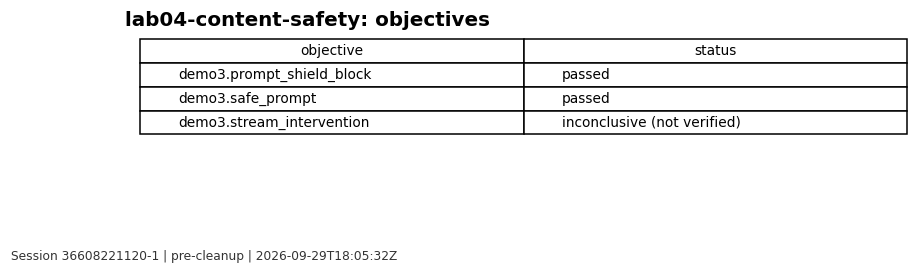
Expected result: the notebook checks the HTTP status, requires text/event-stream, and parses the server-sent events. A confirmed intervention needs policy-specific evidence and records demo3.stream_intervention as passed; a stream that ends early without that evidence is inconclusive; a stream that completes with [DONE] is not_tripped.
The streaming objective is observational: whether the model’s own completion crosses a category threshold is not deterministic, so inconclusive is reported as not verified and does not fail the session verdict. A failed result, such as a transport or protocol error, still fails it.
When the outbound policy detects a violation in a stream, APIM stops forwarding further events instead of returning 403.
Exercise 4.5: Review the session evidence
[!NOTE] Reviewed evidence from session
36608221120-1(workflow run), rendered on 2026-09-29 from sanitized results only. The streaming check is observational:inconclusive (not verified)means the model output stayed below every category threshold, which is not proof of an intervention.
Validation Checklist
- Both inbound and outbound
llm-content-safetyelements are present - The fixture set version is recorded with the results
- Every matrix row has a classification, not only a status code
- Any
403counted as a block carried content-safety provenance - The three Demo 3 objectives have a recorded status
Knowledge Check
- Why is a missing
[DONE]event alone not proof of a safety intervention? - Why does an unrelated authorization
403fail the safety objective? - Who decides the category thresholds, and why?
- What are the two approved responses to a NOT TRIPPED result?
Next Steps
Continue to Lab 05: Mock resilient backend pool.