[!IMPORTANT] Every fixture, rulebook, and calculator output in this lab is synthetic and non-binding. Nothing here represents an actual Desjardins product, rate, or policy, and no regulator or insurer has reviewed or endorsed this material.
Overview
| Item | Value |
|---|---|
| Duration | 40 minutes |
| Level | Intermediate |
| Prerequisites | Lab 10, Node.js 20 or later |
In Lab 07 you read the agent’s applicant message as raw JSON on a terminal. apps/web-chat is the surface that message is written for. It is a FastAPI backend serving a compiled React single-page application, and it is the only place an applicant interacts with the system.
The constraint you proved in Lab 02 and Lab 07 now has a user interface to defend: the applicant never sees a premium.
Learning Objectives
By the end of this lab, you will be able to:
- Run the web chat backend and frontend locally
- Describe the four environment variables the app refuses to start without
- Explain how group membership, not an app role, gates access to the chat
- Trace how a bilingual agent payload is narrowed to a single locale for display
- Explain why a local run stops at the access gate while the deployed origin does not
Exercises
Exercise 11.1: Read the Startup Contract
Select-String -Path apps/web-chat/app.py -Pattern "os.environ\[" | Select-Object -ExpandProperty Line
Expected result: four required variables, AGENT_ENDPOINT, ENTRA_TENANT_ID, ENTRA_CLIENT_ID, and PILOT_GROUP_ID. The three identity values are parsed with uuid.UUID(), so a malformed value fails at startup rather than at first request.
AGENT_ENDPOINT is validated harder than the rest:
Select-String -Path apps/web-chat/app.py -Pattern "must be a Foundry HTTPS endpoint" -Context 3,0
Expected result: the scheme must be https and the host must end in .services.ai.azure.com. The app will not be pointed at an arbitrary URL.
Exercise 11.2 (Hands-on): Build the Frontend
cd apps/web-chat/frontend
npm ci
npm test
npm run build
cd ../../..
Expected result: npm test runs the node --test suites in apps/web-chat/frontend/tests and passes. npm run build writes a compiled bundle to apps/web-chat/frontend/dist, which the backend mounts at / when it is present.
Exercise 11.3 (Hands-on): Run the App Locally
The identity values below are placeholders. They are enough to start the process and render the access gate, which is all this exercise needs.
cd apps/web-chat
$env:ENTRA_TENANT_ID = '00000000-0000-0000-0000-000000000000'
$env:ENTRA_CLIENT_ID = '00000000-0000-0000-0000-000000000001'
$env:PILOT_GROUP_ID = '00000000-0000-0000-0000-000000000002'
$env:AGENT_ENDPOINT = 'https://example-project.services.ai.azure.com/api/projects/demo/agents/quote-preparation/stream'
python -m uvicorn app:create_app --factory --host 127.0.0.1 --port 8200
Expected result: uvicorn reports Application startup complete. There is no module-level app object in apps/web-chat/app.py, so the --factory flag is required.
In a second terminal:
Invoke-WebRequest -Uri 'http://127.0.0.1:8200/api/config' -UseBasicParsing | Select-Object -ExpandProperty Content
Expected result: a JSON document with tenantId, clientId, scope, and environment. The scope is derived as api://<clientId>/Chat.Access. Notice what is absent: the pilot group ID never reaches the browser, because the browser is not the thing that enforces it.
Exercise 11.4: Read the Access Gate
Open http://localhost:8200 in a browser.
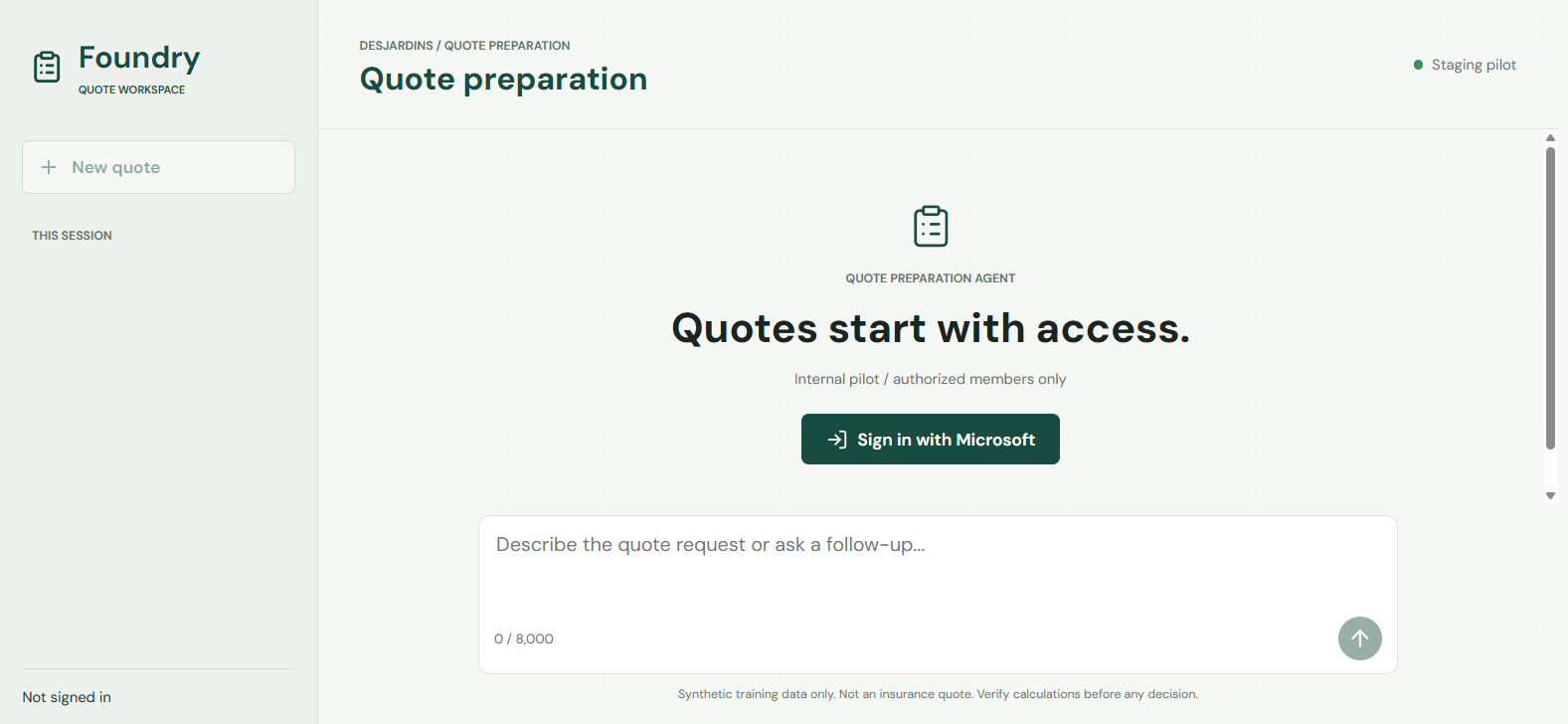
Expected result: the composer is disabled, the sidebar reads Not signed in, and the footer carries the synthetic training data disclaimer. The disclaimer is part of the layout rather than part of a message, so it cannot be scrolled away or displaced by agent output.
The five synthetic demo queries (CASE-SYN-001 to CASE-SYN-005) are not shown yet. The frontend renders them only after sign-in succeeds and the backend confirms pilot group membership. The placeholder identity values from Exercise 11.3 cannot complete a real sign-in, so you see them only against the deployed chat described in Exercise 11.7.
If you select Sign in with Microsoft anyway, Entra ID rejects the request with AADSTS900021: Requested tenant identifier '00000000-...' is not valid. That is expected: the browser sends the placeholder tenant from /api/config straight to the Entra ID sign-in page.
[!TIP] To sign in locally, restart uvicorn with the real
ENTRA_TENANT_ID,ENTRA_CLIENT_ID, andPILOT_GROUP_IDof the deployed chat (az containerapp show -n <web-chat-app> -g <resource-group> --query "properties.template.containers[0].env"), use--port 8000, and browse tohttp://localhost:8000. That is the only local redirect URIscripts/setup-web-chat-identity.ps1registers, and127.0.0.1does not match it. Your account must also be a member of the pilot group, otherwise/api/mereturns 403 and the demo queries stay hidden.
Exercise 11.5 (Hands-on): Trace the Authorization Checks
Open apps/web-chat/auth.py and read PilotAuth.verify.
Select-String -Path apps/web-chat/auth.py -Pattern "raise HTTPException" | Select-Object -ExpandProperty Line
Expected result: seven rejection paths, covering a missing header, an unreachable key endpoint, an invalid signature, and four claim checks. The token signature is validated against the tenant’s published keys, then the claims are checked in sequence:
| Claim | Requirement |
|---|---|
tid | Matches the configured tenant |
azp | Matches the configured client ID |
scp | Contains Chat.Access |
groups | Contains the configured pilot group ID |
The last check is what distinguishes this app from the reviewer app in Lab 12. Chat access is granted by security group membership. Reviewer access is granted by an app role assignment. Both are enforced server side on every request.
Run the backend tests to see those paths exercised:
$env:PYTHONPATH = 'apps/web-chat'
python -m pytest apps/web-chat/tests -v
Expected result: the authorization and application suites pass. The PYTHONPATH assignment is required because these tests import app and auth as top-level modules, and the pipeline sets the same variable for the same reason.
Exercise 11.6 (Hands-on): Prove the Surface Cannot Show a Premium
The agent emits bilingual content, and the backend narrows it to one locale before it reaches the browser.
python -c "
import sys
sys.path.insert(0, 'apps/web-chat')
from app import content_text

payload = {'text': {'en-CA': 'Your request was submitted for employee review.', 'fr-CA': 'Votre demande a ete soumise pour revision.'}}
print(repr(content_text(payload, 'en-CA')))
print(repr(content_text(payload, 'fr-CA')))
"
Expected result: each call returns the sentence for the requested locale. content_text reads only the text field of a content block, so no other field of an agent payload can reach the transcript.
Now confirm where the amount actually lives. In Lab 07 the agent stopped at PENDING_REVIEW without ever placing a figure into applicant_message, and in Lab 13 you will watch that same figure appear in the reviewer UI. The premium is not hidden from the applicant by a filter that could be misconfigured. It is never written into the applicant channel in the first place.
Exercise 11.7: Understand What a Local Run Cannot Do
Sending a message requires two things your local run does not have: a live AGENT_ENDPOINT backed by a deployed hosted agent, and an app registration whose redirect URI points at your local origin.
The deployed chat has both. scripts/setup-web-chat-identity.ps1 registers the deployed origins alongside http://localhost:8000, so signing in against the deployed URL works while the placeholder identity values from Exercise 11.2 cannot.
infra/web-chat.bicep is applied out of band (not through deploy-and-evaluate.yml), and only into the production resource group – there is no staging web-chat deployment.
# Load the azd environment values (AZURE_RESOURCE_GROUP and others) into this session
azd env get-values | ForEach-Object { if ($_ -match '^([^=]+)="?(.*?)"?$') { Set-Item "env:$($Matches[1])" $Matches[2] } }
az containerapp show --name foundry-quote-chat --resource-group $env:AZURE_RESOURCE_GROUP --query "properties.configuration.ingress.fqdn" --output tsv
Expected result: a hostname ending in azurecontainerapps.io. Open it in a browser and sign in with an account in the pilot group. The current URL is also always kept up to date in the wiki’s Deployment Links table.
[!NOTE] The hostname changes whenever the Container Apps environment is recreated, which Lab 14 covers. If sign-in fails with a redirect URI mismatch, the registration is stale rather than misconfigured; rerun
scripts/setup-web-chat-identity.ps1with the current FQDN.
A local run still teaches the part that matters most here. The access gate, the config endpoint, and the locale reduction are all exercised without any deployment at all, and those are the boundaries a reviewer would ask about.
Stop the server when you are finished.
# In the terminal running uvicorn
Ctrl+C
Validation Checklist
npm testandnpm run buildsucceed inapps/web-chat/frontend- The backend starts with
--factoryand reportsApplication startup complete /api/configreturns a scope ofapi://<clientId>/Chat.Accessand omits the pilot group ID- The browser shows a disabled composer and a
Not signed insidebar before authentication - You located all four claim checks in
PilotAuth.verify python -m pytest apps/web-chat/testspasses withPYTHONPATHset toapps/web-chat
Knowledge Check
- Why does
/api/configexpose the client ID but not the pilot group ID? - Why is
AGENT_ENDPOINTrestricted to hosts ending in.services.ai.azure.com? - The chat uses group membership and the reviewer app uses an app role. What does an app role give you that a group does not?
- If
content_textreceives a payload whosetextis a plain string rather than a locale map, what does it return?
Next Steps
Continue to Lab 12: Reviewer Identity and Access.